Feature 2
Interview

GSC Dialogue
- Co-creation of knowledge -

Servant leaders who respond to the needs of the times possess a "symbiotic mind."

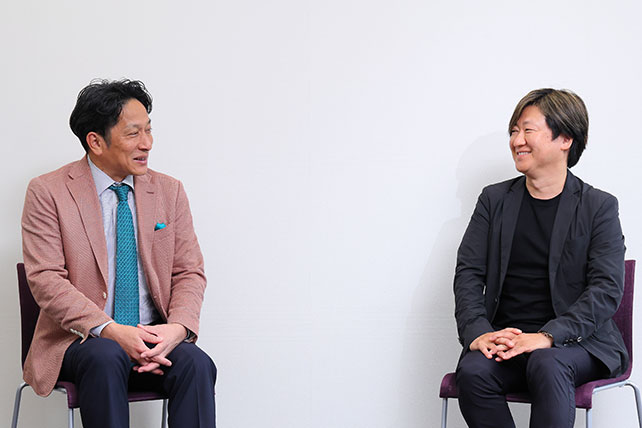
The two, who are both professors at the School of Global Studies and Collaboration (GSC) and are the same age, spoke of wanting to collaborate on something, and a conversation took place between them. Their passionate talk about "leadership" and "a symbiotic mindset" is full of hints for the future.

Professor, Faculty of Global and Social Coexistence

Susumu Hara

Completed the Master's course at the Waseda University Graduate School of Sports Sciences. Master's degree (Sports Science) (Waseda University). In 2004, he became the head coach of Aoyama Gakuin University's track and field team (long distance block). In 2015, he led the team to its first overall victory in the Hakone Ekiden. Since then, the team has achieved brilliant results in numerous competitions, and in 2022, the team won the overall championship in the Hakone Ekiden with a new tournament record. He has held his current position since 2019.

Professor, Faculty of Global and Social Coexistence

Eric Masashi Matsunaga

Graduated from the Master's Program in International Business at the Graduate School of International Politics and Economics, Aoyama Gakuin University. Master's in International Business (Aoyama Gakuin University). Utilizing his experience as a musician, he is active as a business consultant leading the digital age. After working as an executive officer at Accenture, IBM Japan, and Deloitte Tohmatsu Consulting LLC, he has held his current position since 2019.

Accepting differences, empathizing, and encouraging each other is what makes studying at GSC so appealing.

EricGSC is a faculty that is exactly what is needed in this day and age. It is a faculty that is adapted to the changes of the VUCA era, where experts from various fields gather, empathize, and coexist. As a business consultant, I have been involved in cutting-edge international business and cutting-edge digital innovation. The keywords ESG (Environment, Social, and Governance) are now very important in companies. Companies that do not take into consideration the ESG perspective, which is important for companies to aim for long-term growth, will not be looked at by investors. We are in an era where users and shareholders will not look at companies that do not contribute to society or work to solve social issues. Business and social issues are integrated, and GSC students who have studied social issues are the talent that companies need. It is also interesting that it focuses on Asia. From now on, Asia will be the key to changing the world. Asia will unite the world on a global scale. This faculty was founded with the idea that Japan will lead such a big role, so I think it is very meaningful to study at GSC in this day and age.

Hara: I've been told since I was a child that I'm not cooperative. I don't think that's true, but the world is always making us feel like we have to conform. Even if you have a different opinion, it creates a climate where you have to go along with the people around you, and if you express your own beliefs, you're criticized for not being cooperative. There's no way there's any development in that kind of environment. I feel that GSC has a culture where people exchange and acknowledge various opinions and see things in terms of right and wrong. The teachers practice an education where students acknowledge each other's fields and communicate their own thoughts, and in my classes, there are many students who honestly express their beliefs. The Aoyama standard subject "Career Design Seminar" is taken by students from multiple faculties other than GSC, but the most energetic of them are the GSC students. I would like to convey the wrong way of thinking about cooperation, and this faculty has a culture where we can acknowledge each other's opinions.

Eric: I think that the faculty should be the first to demonstrate "symbiosis." I was originally an artist, and Professor Hara is an athlete. We are always discussing how we can collaborate. In the first place, it is not possible for two people with different fields of expertise to collaborate so amicably like this. But this is GSC. We have a professor who is very knowledgeable about international development and Thai culture, and a professor who is famous in the field of spatial information, who uses drones to create the latest maps of disaster areas, and even though our fields of expertise are different, we run the faculty with the same vector. I would like students to feel and learn about "symbiosis" from us. Symbiosis starts with empathy, and the basis of empathy is respect. Because faculty members respect each other, students can respect each other, and they can respect the people at their study abroad destinations. I think that is the color of GSC.

The former director of the Geospatial Information Authority of Japan, Mr. Hara, said, "Mr. Hara, is there anything we can do to help?" and gave us some footage of Hakone, saying, "Please use it." We did image training while watching the footage. There was also a professor who created a 3D image of Hakone taken from a drone.

Eric: That was amazing. It's a good relationship where experts in different fields cooperate generously. They don't pander to what others say, but acknowledge each other and say, "That's interesting." At the root of it all is respect. That's why there are no teachers at GSC who can't listen to other people's opinions and say, "Are you going to tell me what to do?"

Hara: That's right, everyone is receiving a good education. I advise track and field club members to take seminars whenever possible. By taking them, they can demonstrate an extra level of ability. Everyone's records improve. This is all thanks to the education of the teachers. The teachers think seriously about how to educate the students, so I can leave it to them with peace of mind, and I would like to leave it to them instead.

Eric: As expected, students can empathize with it. I often have students talk about their lives. This is because I always want to draw out what exists deep inside them and empathize with them, rather than just looking at the superficial results. There are many small successes and, of course, failures. There is also a process, so seeing that is a learning experience for those around you. It makes you think, "It's so wonderful to work so hard like this." You can use that in business or to address social issues.

It is essential for a leader to exercise self-discipline based on a shared philosophy.

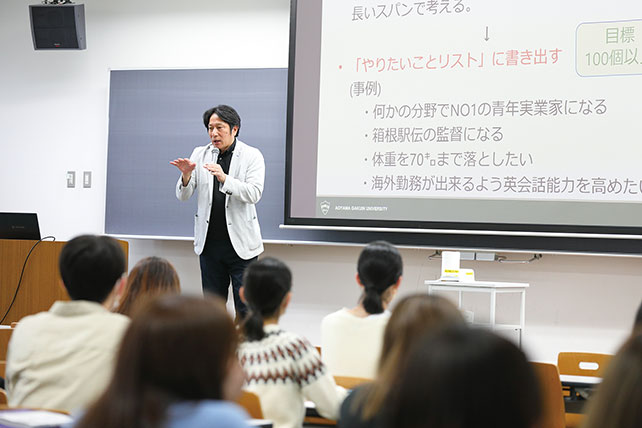
HaraThe way leaders are perceived varies depending on the type of organization, but an organization is a group of people who come together to do something. Therefore, there must be a philosophy and a vision. When the philosophy and vision have not permeated the entire organization, a top management type of leadership approach should be used, and when everyone gradually starts to share the philosophy and think and act for themselves, it is inevitable that the leadership style will change to a servant type that serves and leads. There are various management methods, and organizations should be created with the idea that the answer varies from time to time. The basis for this is sharing the philosophy.

This year marks the 19th year since you became the head coach of the Eric Athletics Team. As a business consultant, I have seen many large organizations and I think that the leadership model that is needed now is the one that Mr. Hara created. There is a transfer of responsibility, I guess. It's possible because of a relationship of trust. While many teams are micromanaged, Coach Hara has freedom. It is because of this freedom that they take responsibility independently. When each individual feels a sense of responsibility, it actually means that everyone is demonstrating leadership. Now is not the time when one leader can win by being strict and strong, so I feel that the leadership model that the times are looking for is here. The same can be said for companies. There are parts of Mr. Hara's management that are very inspiring, and I think that if we could apply that to a company with a scale of 50,000 people, Japan would improve. It would be interesting if I could do it as a business consultant.

Everyone searches for answers because they think there is a fundamental answer, but in the world there are no answers to begin with. We live in an age where we don't know what the right answer is. In my classes, I try to draw out each student's thoughts by saying, "There are no answers to begin with. What you say and think is the answer." This is the same for the track and field club.

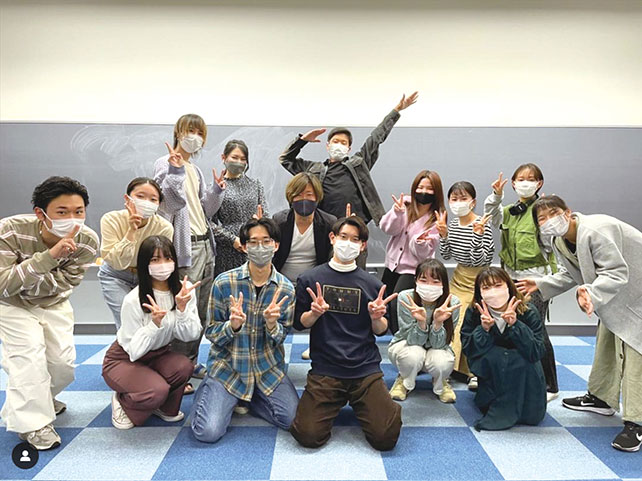
Eric: In my case, I can hear the opinions of both Professor Hara and the students because the track and field club students are also in the seminar. This is actually very educational and makes me think, "I see." When it's one-way, everyone talks arrogantly, but when I hear the students' voices, I think that Coach Hara's unique leadership is what motivates everyone.

There are infinite thoughts of each primitive human. There is only one fact, but the truth is each person's own thoughts. We get angry when the truth is false or without morals, but we accept positive truths. That is also the GSC way of thinking. The key is knowing when and how to flip the switch in the person's mind. To do that, we need to be constantly watching the students' truth and thoughts. It is also important to acknowledge that and have a sense of equality. We make sure that each student properly understands the position and facts of their abilities, and then think about how to help them grow from there. People are happy because they grow through hardship. Whether it's academics or sports, isn't it important to develop them step by step?

Eric: What we are teaching is not knowledge, the era of knowledge is over. Education has changed, the role of teachers has changed, and students have changed. The important thing is to have a mindset of continuing to learn. If you don't learn, you won't grow. My policy is that "education" is "co-education." I tell my students, "Let's learn and grow together."

Hara: If you don't think clearly and take leadership roles, no one will listen to you. It's important to think logically and have knowledge of management and leadership theory, as well as organizational theory, psychology, science, etc. It is also GSC's mission to develop leaders with a "coexistence mindset" that will lead the times.

Eric: Our next step is to give shape to these relationships and spread the word. We want to create collaborations that go beyond our respective fields of expertise. I don't think other universities could ever replicate the circle of empathy that exists at GSC, so we want to see the results of that. That's our next goal.