
Doctoral Program Support
AGU
Future Eagle Project
Aiming to nurture excellent doctoral students with the themes of "integration of humanities and sciences" and "internationality"
As social systems become more complex, graduate schools and doctoral programs that conduct highly specialized research are drawing renewed attention. Our university also launched a new program called the AGU Future Eagle Project (FEP) in November 2021 to support students in doctoral programs (and students in their third year or above of integrated doctoral programs). In this article, we will introduce the background to the launch of FEP and some key points.
 What is the AGU Future Eagle Project?
Director of AGU Future Eagle Project, Assistant to the President for Industry-Government-Academia Collaboration, Professor, Department of Electrical and Electronic Engineering, College of Science and Engineering
Shinji Huang
In 2000, he completed his doctoral studies in the Department of Physics Engineering at the Graduate School of Engineering, the University of Tokyo. He received his PhD in Engineering from the University of Tokyo. After working as an assistant professor at the University of Tokyo, an assistant professor at Tohoku University, and an associate professor at the Nara Institute of Science and Technology, he was appointed associate professor in the Department of Electrical and Electronic Engineering at the Faculty of Science and Engineering, Aoyama Gakuin University in 2013, and became a professor in 2018. He is the director of the Nano Carbon Device Engineering Institute, director of the Integrated Project Research Institute, and deputy director of the Liaison Center. His specialties are crystal growth, physical property evaluation, and device applications of functional materials. He began full-scale research on the crystal growth and device applications of graphene (a sheet-like material composed of carbon atoms) at Aoyama Gakuin University, and is currently working on the thermal CVD growth of single-crystal graphene on iridium, graphene transparent antennas, and graphene electrochemical devices. He is a member of academic societies such as the Japan Society of Applied Physics, the Electrochemical Society, and the New Diamond Forum.
青山学院大学の研究最前線(AGU NEWS 101号特集)
VIEW DETAIL →

(AGU NEWS No. 101 Special Feature)
VIEW DETAILS →
FEP is our university's first university-wide doctoral student support program. The students are expected to have the potential to pioneer new fields and areas in academia and business, and will receive comprehensive support over the three years of their doctoral studies, including research expenses, living expenses, and training programs. The project name "Future Eagle" is inspired by our university's mascot character, "Ego."
■ Background to the launch of FEP
The background to the launch of FEP is the problem of "Japan's declining research capabilities." As reported in the "Science and Technology Indicators" report created by the National Institute of Science and Technology Policy, the number of people receiving doctoral degrees in Japan is decreasing compared to other countries. To address this issue, the Japan Science and Technology Agency (JST) announced the "Challenging Research Program for Next-Generation Researchers (JST-SPRING)." This is an initiative to support doctoral student support measures at each university using public funds. Meanwhile, our university has been supporting doctoral students since before the announcement of the JST program. As our university's support track record was highly evaluated in the project review by JST, FEP was selected as a target project for 2021, and this led to the implementation of FEP. In accordance with JST regulations, FEP will be implemented as a five-year project from 2021 to 2025.

■Four Pillars of FEP
The main features of FEP are
1) Interdisciplinarity
②Transferable skills (generalized abilities)
③Career path support
④ Financial support
These are the four points:
1) Interdisciplinarity
In order to conduct innovative research, it is important to delve deeply into one's own field of expertise while also acquiring a broad perspective by integrating with other fields. At FEP, we are particularly conscious of "interdisciplinarity." A secondary supervision system by faculty members in a field different from the student's specialty For example, in the case of a pairing of "a student researching sociology with a data science instructor," a sociology student, a liberal arts student, can learn the methods and ideas of data science, a science student, and refine his or her research to be more objective and persuasive. In the case of a pairing of "a student researching autonomous driving systems with a psychology instructor," a student can learn about the psychology of drivers and refine their research into driving systems.

②Transferable skills (generalized abilities)
"Transferable skills" are versatile abilities that can be used regardless of field. For example, doctoral students acquire advanced skills in practical and other comprehensive abilities while performing daily practical tasks, such as planning and effectively utilizing allocated budgets. Another characteristic of doctoral students is that they acquire a methodology for examining things in their essence based on accurate data, and it is these examination skills that are "transferable" and can be used in any field. In addition, FEP supports short-term study abroad and provides workshops, focusing on cultivating the international perspective and English language proficiency that are necessary in any field.
③Career path support
In foreign countries, doctoral students are highly valued for their transferable skills, and those with doctoral degrees are actively employed by companies in various fields. We hope that in the future, the potential of doctoral students will also be evaluated more in Japan, and that meaningful career paths will be formed for both students and companies. FEP aims to create career paths for students who have completed doctoral programs by utilizing the Ministry of Education, Culture, Sports, Science and Technology's "Job-based Research Internship System" and our alumni association network. We hope that students who have both high expertise and transferable skills will actively expand their fields of activity beyond academic paths, such as finding employment in general companies, or working in the world of politics or journalism.
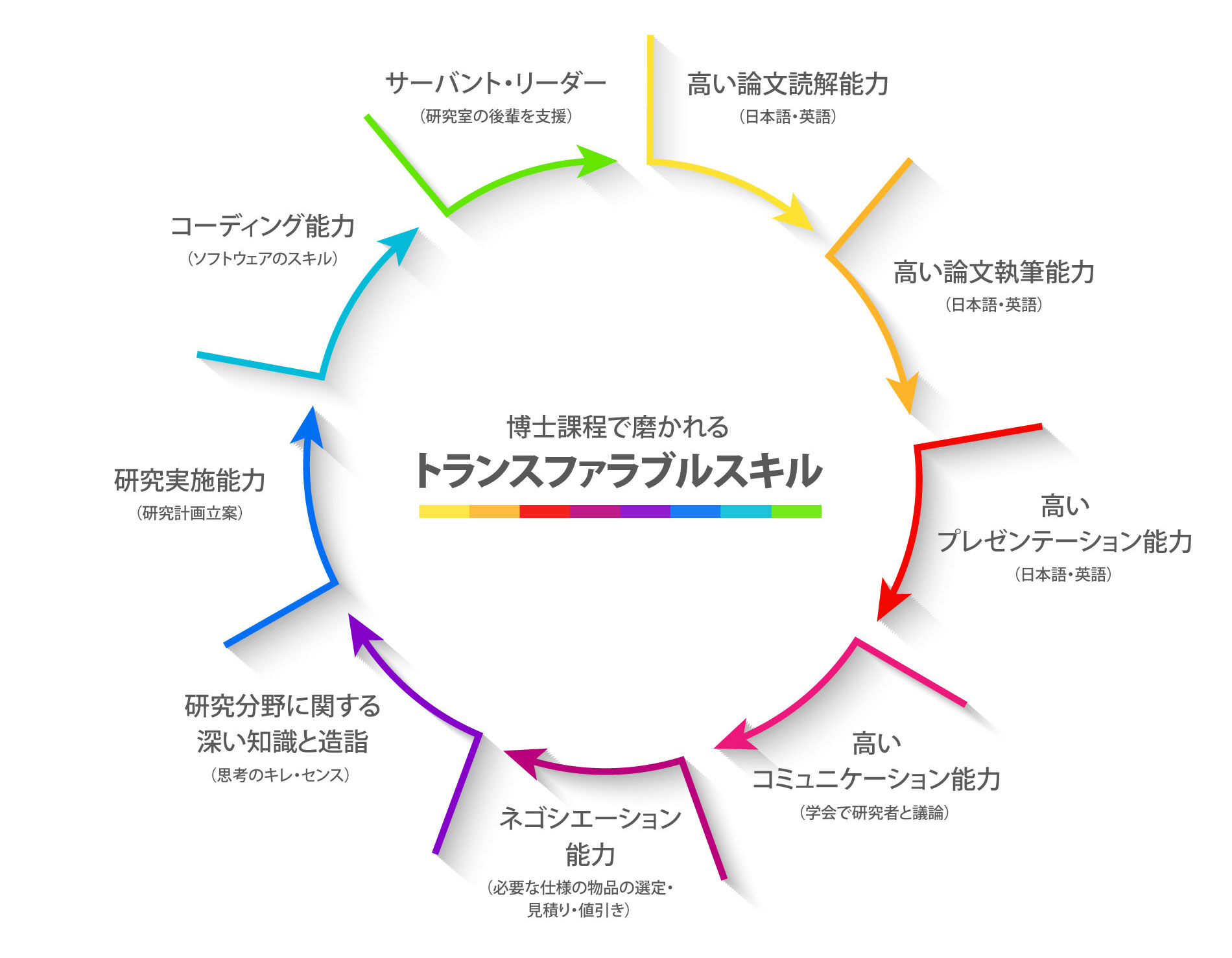 In the doctoral program, you will hone transferable skills that can be used in a variety of fields, industries, and occupations.
④ Financial support
In addition to the existing support system of Young Researchers Scholarships (effectively free tuition), FEP will help cover research and living expenses. support We are also actively involved in this. The aim is to create an environment in which students can settle down and concentrate on their research activities without being restricted by financial issues. Our university's various support measures for doctoral programs have been praised in many places, and in recent years, an increasing number of students are moving on to our doctoral programs from other universities in search of an excellent research environment. Support for doctoral students also plays a part in cultivating our university's brand as "Aoyama Gakuin University with research capabilities."
Universities have two main functions. One is broad "education" as represented by undergraduate schools, and the other is advanced "specialized research" as represented by graduate schools. It is expected that social needs for this "specialization" will increase in the future. Therefore, acquiring advanced expertise and obtaining a "doctoral" degree as proof of that expertise will be a great support in the international community in the future. Our university believes that we should continue to make similar efforts to strengthen our research capabilities even after FEP.
For students and working adults who are considering re-learning in a specialized field, we would like you to consider "honing your expertise at Aoyama Gakuin" and "conducting research at Aoyama Gakuin" as career options.
 It is expected that the social need for "expertise" will continue to increase. It is important to delve deeply into expertise while cultivating a broad perspective.

Main support systems for graduate students implemented by our university
Please check the link page for details.
| Support measures | AGU Future Eagle | Main support systems for existing doctoral students |
|---|---|---|
| scholarship | Tuition for the standard period of study for doctoral programs and the 3rd to 5th years (3 years) of integrated doctoral programs will be essentially free of charge
|
|
| Cost of Living | Research grants, etc. 180,000 yen per month |
A system in which doctoral students or graduate students in their third year or higher of a doctoral program are employed as graduate assistants to provide advanced support such as lecturing and training for undergraduate students and running international conferences while prioritizing research. A system in which a researcher assists with lectures and practical training for undergraduate students while engaged in research. Monthly salary: 160,000 yen (up to 3 years of employment) Number of people hired: 18 people in FY2020 *FEP students cannot use both programs at the same time (please consult with us if you wish to switch programs) |
| Research Funding | Research Grants Research funding: 250,000 yen/year |
Competitive research grants for doctoral students, assistants, assistant professors, and other young researchers Doctoral student support amount: 250,000 yen, 12 cases/year
|
| Promoting participation in international conferences Annual participation subsidy |
Travel support program for master's and doctoral students to present at international conferences Up to 70,000 yen for domestic events, up to 150,000 yen for overseas events
|
|
| Guidance/Training | Vice Leadership System Creating a system that crosses disciplines and integrates the humanities and sciences |
|
Workshops and seminars Cooperation from two outside expertsCooperation by graduates of our university is planned |
||
Study Abroad Support System Only for those who wish to attendExpected to last up to 3 months |
Interview with scholarship students
Promoting interdisciplinary research into the EU and world peace
Ayumi Otsuki, 2nd year doctoral student, Department of International Politics, Graduate School of International Politics and Economics
[Research title] EU citizen identity and tolerance of others
I have always had a strong interest in issues of discrimination and world peace. This stems from my childhood experiences of reading picture books about the Holocaust and visiting the Atomic Bomb Dome in Hiroshima. Now, as a doctoral student, I am conducting research on the theme of "EU citizen identity and tolerance towards others."
As someone who has always been interested in the connections between people and society, I have always valued the perspective of social participation in my research. In this regard, I had the impression that science and engineering fields are proactively pursuing joint research with general companies, and that the results of social participation are concrete. Therefore, I aimed to gain research hints from science and engineering fields by participating in FEP, which promotes "interdisciplinarity" as a key point of student support.

An interdisciplinary perspective is also effective in brushing up on research content. For example, my specialty, international politics, is generally considered a liberal arts field, but by incorporating social informatics and data analysis methods, which are considered science fields, I think my research content has become more persuasive. To hone my data analysis skills, I took advantage of FEP's short-term study abroad program. I studied at ICPSR (Inter-university Consortium for Political and Social Research), an American university association for political and social research, where I learned advanced techniques in data analysis and was exposed to the research field of REP (Race, Ethnicity & Politics), which gave me a new perspective on the issue of discrimination, which is my research topic.
In addition, the financial support from FEP has enabled me to create a favorable research environment. I no longer have to worry about my research time being cut off by part-time work to earn money for specialized books and equipment, so I can focus on my research with peace of mind.
Currently, I am conducting research on the broad theme of "peace," with a focus on the EU. In the future, I would like to further deepen this research and produce results that are universal and can be applied to other Asian regions.

Using statistics to consider international peace from a gender perspective
Graduate School of International Politics and Economics, Department of International Politics, Doctoral Student, 2nd Year
[Research topic] Do women bring peace? - Empirical analysis of women's political participation and inter-state conflict -
I am currently conducting research on the theme of "What impact does female political participation have on international peace?" I have been using statistical methods to examine this topic since my master's degree, and in my master's thesis I came to the conclusion that "the higher the ratio of female legislators, the lower the possibility of inter-state conflicts occurring."
After moving on to the doctoral program, I took advantage of FEP's short-term study abroad program to study abroad at ICPSR, the world's largest data archive, to further hone my statistical skills. At ICPSR, I learned analytical techniques such as "time series analysis" and "causal inference methods," which I used in writing my doctoral thesis. I also gained a lot from FEP's "interdisciplinarity." In particular, I was co-supervised by a professor from the Faculty of Social and Informatics who specializes in energy economics, which gave me new perspectives on the relationship between a nation's oil production and gender.

The FEP also provided a great deal of support financially. As an international student, the impact of COVID-19 was huge for me, and I was hit hard by the loss of part-time work, but with the support of the FEP, which is available to all scholarship students regardless of nationality, I was able to focus on my research again with peace of mind.
In Japan, gender studies based on a sociological perspective are common, but gender studies based on the perspective of international relations are expected to develop in the future. I will continue to conduct research on the themes of international relations and gender, and in the future I aim to find a job in Japan related to research or education.
 From a master's thesis. As the ratio of female legislators increases, the likelihood of participating in an interstate dispute, the likelihood of initiating an interstate dispute, and the severity of an interstate dispute (indicating the number of deaths and the level of the conflict) tend to decrease. Data samples were collected from 192 countries around the world (1995-2009).
Developing a new nucleic acid detection method using original molecules
2nd year doctoral course, Department of Science and Engineering, Graduate School of Science and Engineering
[Research title] Development of high-precision SERS probes aimed at multiplexed imaging
Hiroki Makinae
The Graduate School of Science and Engineering has established a rich research environment and support system, which allows students to present excellent research results while still enrolled. Makinae is working on a study of intracellular nucleic acid detection using Raman scattering light measurement.
VIEW DETAILS →
Continuing the dream of becoming an astronomer discovered while studying abroad
Graduate School of Science and Engineering, Department of Science and Engineering, 1st year doctoral course
[Research Project Title] Study on prompt emission of gamma-ray bursts in the soft X-ray region
Sei Kensho
Originally from Taiwan, Mr. Sheng aspires to become an astronomer and is currently studying astronomical phenomena in his doctoral program at the Graduate School of Science and Engineering. He left his home country to enroll at our university, broadening his horizons and deepening his expertise. He talks about his current plans for the future.
VIEW DETAILS →
2022 FEP Scholarship Student
| full name | Affiliation | Research Project Name | Main Supervisor | Assistant Supervisor |
|---|---|---|---|---|
| Satoshi Nomaguchi | Graduate School of Literature, Department of English and American Literature Doctoral course 3rd year |
Theoretical study of the interaction model between abstract meanings and the environment that produces ambiguity | Faculty of Literature, Department of English and American Literature Professor Shoichi Takahashi |
Faculty of Science and Engineering, Department of Information Technology Assistant Professor Motoki Yatsu |
| LI TIANCHONG | Graduate School of International Politics and Economics International Politics Doctoral course 3rd year |
Diseased Democracies: Pandemic Responses and Democratic Backsliding |
School of International Politics and Economics Department of International Politics BOYD, James P. Associate Professor |
Faculty of Science and Technology, Department of Electrical and Electronic Engineering Professor Shinji Huang |
| DUAN MAOMAO | Graduate School of Science and Engineering, Department of Science and Engineering Doctoral course 3rd year |
Sprites and gamma ray emission from thunderclouds: Elucidation of the origin of lightning by TGF | Faculty of Science and Engineering, Department of Physical Sciences Professor Takanori Sakamoto |
Faculty of Economics General Education and Foreign Language Courses Professor Kazutaka Kishida |
| Yoshiaki Yamazaki | Graduate School of Science and Engineering, Department of Science and Engineering Doctoral course 3rd year |
Proposal of a distributed expression correction method using vocabulary knowledge constructed from text data | Faculty of Science and Engineering Department of Information Technology Professor Gozo Ohara |
Faculty of Social Informatics Department of Social Informatics Professor Yutaka Miyaji |
| Seima Ohyama | Graduate School of Social Informatics Social Information Studies Doctoral course 3rd year |
A case study on the experience and mechanism of alloprojection | Faculty of Social and Information Studies Social Information Department Professor Kohtaro Takagi |
College of Community and Human Sciences Community Human Sciences Associate Professor Shigeo Kawashima |
| Shusuke Ichikawa | Graduate School of Letters, Department of History Doctoral course, 2nd year |
A Study on the Chief Cabinet Secretary of the Eisaku Sato Cabinet | Faculty of Letters, Department of History Professor Kyo Komiya |
Faculty of Economics Department of Economics Professor Shuichi Takashima |
| TUNG WENCHUNG | Graduate School of Letters, Department of History Doctoral course, 2nd year |
A comprehensive study on the Shanghai Institute of Natural Sciences School of Medicine: Research institutions and their people under the perspective of colonial medicine | Faculty of Letters, Department of History Professor Wataru Iijima |
Tokyo Medical University Faculty of Medicine Lecturer: Hiroki Inoue |
| Ayumi Ohtsuki | Graduate School of International Politics and Economics International Politics Doctoral course, 2nd year |
EU Citizen Identity and Tolerance of Others | School of International Politics and Economics Department of International Politics Associate Professor Ken Takeda |
Faculty of Social Informatics Department of Social Informatics Associate Professor Shinya Obayashi |
| CHEN ZHAOYU | Graduate School of International Politics and Economics International Politics Doctoral course, 2nd year |
Do women bring peace? - Empirical analysis of women's political participation and interstate conflicts - | School of International Politics and Economics Department of International Politics Associate Professor Kentaro Sakuwa |
Faculty of Social Informatics Department of Social Informatics Professor Hiroyuki Ishida |
| Hiroki Makinae | Graduate School of Science and Engineering, Department of Science and Engineering Doctoral course, 2nd year |
Development of high-precision SERS probes for multiplex imaging | Faculty of Science and Engineering Department of Chemistry and Life Sciences Professor Kazuhito Tanabe |
Faculty of Business Administration, Department of Marketing Associate Professor Akira Yokoyama |
| Taiga Nakagawa | Graduate School of International Politics and Economics International Politics Doctoral course 1st year |
China's "Attempts to Exert Influence Without Armed Attack" against Japan and its Impact on the Japanese Government and Society | School of International Politics and Economics Department of International Politics Professor Jaehwan Lim |
Faculty of Science and Engineering, Department of Information Technology Professor Gozo Ohara |
| Sheng Chiang | Graduate School of Science and Engineering, Department of Science and Engineering Doctoral course 1st year |
Study on prompt emission of gamma-ray bursts in the soft X-ray region | Faculty of Science and Engineering, Department of Physical Sciences Professor Takanori Sakamoto |
Graduate School of Accounting Profession Accounting Profession Major Professor Makiko Shigeta |
| Kota Ujibe | Graduate School of Science and Engineering, Department of Science and Engineering Doctoral course 1st year |
Understanding aging using zebrafish | Faculty of Science and Engineering Department of Chemistry and Life Sciences Professor Fuzo Hirata |
Faculty of Comprehensive Cultural Policy, Department of Comprehensive Cultural Policy Professor Shinichi Fukuoka |
| Masaru Kuromatsu | Graduate School of Science and Engineering, Department of Science and Engineering Doctoral course 1st year |
Flexible device application using single-walled carbon nanotube ink | Faculty of Science and Engineering Department of Electrical and Electronic Engineering Professor Shinji Huang |
Faculty of Social Informatics Department of Social Informatics Professor Yasuhiro Iijima |
| Kitazawa Yuuki | Graduate School of Science and Engineering, Department of Science and Engineering Doctoral course 1st year |
Establishment of a driver model for driving a car using a machine control approach | Faculty of Science and Engineering Department of Mechanical Engineering Professor Yoshiki Sugawara |
Faculty of Education and Human Sciences Department of Psychology Professor Reiko Yakushigami |