
To never stop learning
Message from Vice President
From 2020 to 2021, the spread of COVID-19 infection led to an unprecedented situation, with the government issuing a state of emergency declaration, which resulted in school closures and entry restrictions at both Aoyama and Sagamihara campuses. In 2020, classes were generally conducted online, except for those deemed possible to be held face-to-face. We spoke with Vice President INAZUMI Hiroshige about the preparations that were made to ensure uninterrupted university learning, the challenges that arose along the way, and the university's future direction.

Professor, School of Social Informatics Department of Social Informatics
Hiromasa Inatsumi
D. in Mechanical Engineering from Waseda University Graduate School of Science and Engineering in 1956. D. in Engineering (Waseda University). 1993 appointed as the University's College of Science and Engineering He has served as Vice President of the Center for Information Science and College of Science and Engineering Academic Affairs Chief, Director of College of Science and Engineering and Director of the Graduate School Graduate School of Science and Engineering since 2004, Director of School of Social Informatics and Director of the Graduate School Graduate School of Social Informatics since 2010, and Director of the Student Counseling Center since 2016, respectively. He is a member of the Institute of Electronics, Information and Communication Engineers, the Japanese Society for Artificial Intelligence, and the Information Processing Society of Japan.
 Online classes began with limited preparation time.
Please tell us about any trial and error you went through.
In the 2020 academic year, all preparations had to be made in about one month until the first day of classes on May 1st. For faculty members, the video distribution system "Webex" was introduced in addition to "CoursePower," which had been in operation at the university for some time as a teaching support system, and the Information and Media Center then opened an "Online Class Support Site" to gradually provide information on how to use CoursePower and Webex and how to link them. Support for those in charge of classes was left to the assistance of many people, including staff in the relevant departments.
The Information Media Center and the Information Strategy Promotion Committee, comprised of members with ICT knowledge selected from each faculty, were at the forefront of the response, and they repeatedly identified issues in implementing online classes and held discussions to resolve them, sharing information university-wide as they moved forward.
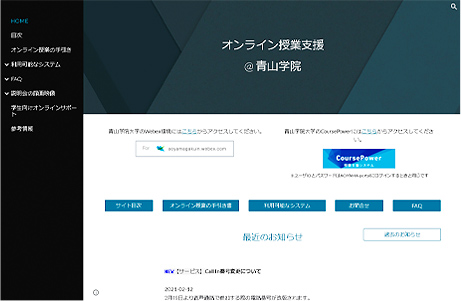 Online class support site
Meanwhile, to see whether students are in an environment where they can take online classes, we looked at the English placement test taken by freshmen. Freshmen took the test in an online environment at home, and the test-taking rate was about 95%, indicating that the ICT environment is relatively well-developed.
To conduct online classes, both faculty and students must prepare the necessary equipment and create an environment for conducting classes. I imagine it was difficult for each person to prepare, including the communication environment. Regarding preparations for online classes, we delayed the start of classes by about one month to May 1st, assuming that we would respond in detail, including face-to-face classes. However, after the government issued a state of emergency declaration, entry to the campus was completely prohibited, so unfortunately we were unable to provide face-to-face support. We tried to communicate in an easy-to-understand manner through the student portal and online class support site, but I imagine that students had a lot of difficulties. Indeed, we had no choice but to prepare online for the completely unknown endeavor of online classes.
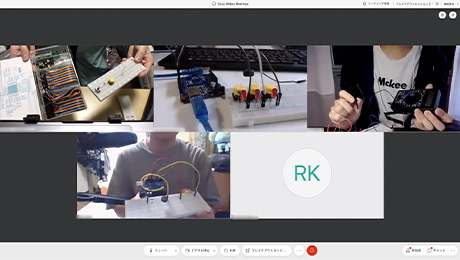 In the Information Science Seminar (Assistant Professor Yoshida Aoi, School of Social Informatics)
Group work
In particular, many staff and faculty members at the university racked their brains to think of ways to help new students who had never yet accessed the campus or our information systems to take online classes. Looking back, new students were eventually able to participate in online classes, but I think there were many hardships along the way.
Shortly after the online classes began, we also had an incident where the CoursePower system went down. This was because, while normally only one course can be taken at a time, students were able to take any course online before registering for classes. This was a very good service for students, but it put an excessive load on the system. In addition to this, we were able to solve various other issues unique to online classes, and we managed to get the system running stably after course registration was completed.
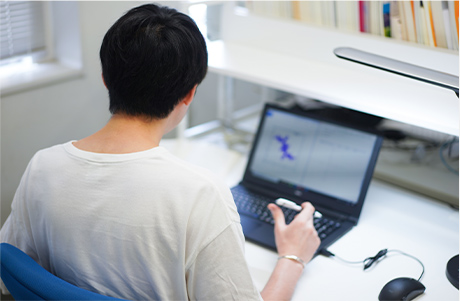 Online classes begin after trial and error
Please tell us about the considerations and ideas you took into account when distributing the content.
There are three types of online classes: 1) real-time classes where live lectures are given, 2) on-demand classes where students watch recorded videos, and 3) self-study classes where students are given assigned tasks.
Instructors decide on the class format by taking into consideration the size of the class, the characteristics of the subject, the environment of the students taking the class, etc. When you try it out, you will find that it is not possible to immediately decide which format is best.
We discovered that on-demand classes have the advantage of allowing students to learn repeatedly, while real-time classes allow students who normally cannot speak up during class time to participate in discussions. We also discovered that by utilizing the functions of web conferencing systems, we can carry out interesting activities that are not possible in person, such as allowing guests from overseas to join in on short notice and conducting virtual group work.
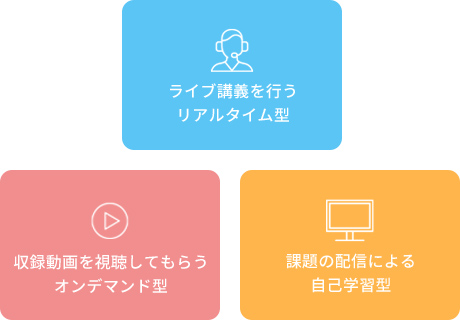 Definition of online classes
In addition, online classes inevitably require more assignments. This time, regular exams were not held, so in-class evaluations were required, and instructors had to assign assignments to students during class. If you can see the students' faces, you can see their level of understanding and how they are working, so you can make some adjustments, but online classes do not have this, so there are more assignments. This became a heavy burden on students, especially those who are working sincerely. The Religious Center and Student Counseling Center, feeling a sense of crisis about this, worked together to send a message to each instructor saying, "Take it easy a bit." I think that each department and person in charge, both on and off the job, cooperated to somehow make online classes go smoothly.
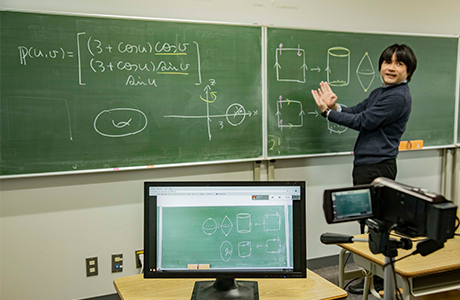 We turn the classrooms used for seminars into studios.
Teaching using a blackboard (Assistant Professor Masashi Takamura School of Social Informatics)
Approximately 20-30% of students returned to their hometowns and took online classes. International students who are unable to enter Japan can only participate remotely. In other words, even though face-to-face classes became possible in 2020, online classes could not be eliminated altogether. As we move forward with online classes and discover not only their difficulties but also their effectiveness, we will now have to think about how to bring students back to campus. This seems to call into question the very meaning of the campus as a "place" for learning.
Meanwhile, students were actively using social media to recruit others to join clubs. The university also held an online open campus, and the strength of our students is their "flawlessness" that has not given up even in the midst of this COVID-19 pandemic. By thinking about how to utilize online activities outside of class, students will reconsider the meaning of universities and campuses as a place to share information with various peers. Both Aoyama and Sagamihara campuses are hubs of "knowledge," and this is a good opportunity to reaffirm their meaning.
 Students who actively recruited members to their clubs using SNS
(image)
Please tell me what support will be provided for new students who are unable to come to campus.
Since there were few opportunities for new students to enter the campus, we held a "New Student Welcome Day" at both the Aoyama and Sagamihara campuses from August 31 (Mon) to September 4 (Fri), 2020. Since things were still in a state of chaos, it seems that both the university and the participants were still awkward. After that, over the winter, the second round of Welcome Days were planned independently by each faculty and department, and various online exchanges were held, gradually increasing the opportunities for direct interaction between faculty and students. In addition, the entrance ceremony, which was temporarily canceled due to the COVID-19 pandemic, was held on March 31 (Wed), 2021. This seemed to be more meaningful for the students than we had imagined. For faculty and staff who were able to see this, it was a reminder of the importance of efforts to maintain campus functions. We hope that after this, you will have a fulfilling student life from April onwards.
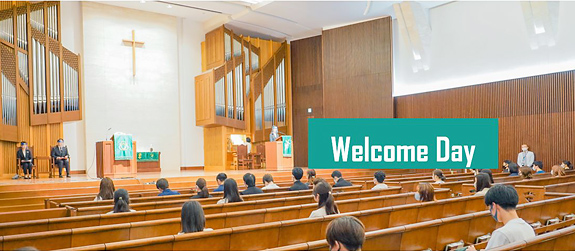 "New Student Welcome Day" to welcome new students to each campus
Please let me confirm the faculty's class implementation policy for the 2021 academic year.
In September 2020, we announced that "in 2021, we will proceed with preparations to hold face-to-face classes as a general rule." We have been making various preparations based on this basic policy. Given the current infection situation in the Tokyo metropolitan area, the situation remains unpredictable, but it is the university's mission to continue learning and work to enrich student life. Over the past year, we have learned many lessons and received both a lot of support and a lot of criticism. Using all of this as fuel, we will begin our efforts to seek a new vision for what a university should be.
 University class (image)
Basic class management for the 2021 academic year
We are considering various types of classes for each course based on the experience of the past year. In the first half of the 2021 academic year, approximately 70% of courses will be face-to-face, and approximately 30% will be online, with classes being conducted on the assumption that students will attend classes in person.
As mentioned earlier, there are various advantages to introducing online classes. A typical example is when repeated learning is effective. In addition, the effectiveness of flipped classrooms, in which students study in advance and then conduct face-to-face practical classes, is also widely recognized. We hope to see many such initiatives being adopted in 2021. In this way, the goal of classes in 2021 is to conduct face-to-face classes with direct interaction between the instructor and students, and to conduct online classes that further enhance these. However, depending on the infection situation, we also anticipate cases where we have no choice but to conduct online classes in order to maintain the health of instructors and students and prevent infection on campus. Taking all of these factors into consideration, the 2021 class plan has been created.
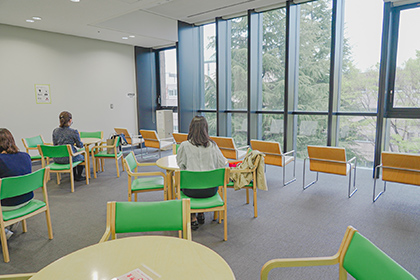 Lounge in Building 17 on Aoyama Campus
Unfortunately, depending on the future infection situation, we may have to once again focus on online classes. However, we believe that we must create a system that allows first-year and second-year students in 2021 to take face-to-face classes as much as possible.
As classes begin in 2021, we are working to ensure safety on campus by establishing infection prevention measures for each facility, including classrooms, and methods for publicizing these measures. In addition, since it is expected that face-to-face and online classes will coexist on campus, we are particularly working to improve the convenience of shared facilities such as vacant classrooms and lounges on campus and to improve the environment for using information devices. Of course, we plan to keep facilities such as libraries, public PC rooms, and CALL classrooms open as much as possible while taking thorough infection prevention measures. We expect to be asked how we should revise and change our operational policy depending on the future infection situation, but we will focus on maintaining a system that allows us to properly function as a university.
Finally, there is the issue of consideration for students with various circumstances amid the COVID-19 pandemic. Our university is responding to students who need consideration in attending face-to-face classes for unavoidable reasons, such as students with underlying medical conditions that make them more susceptible to becoming seriously ill if infected, and international students who are unable to enter Japan. Specific measures will be implemented in a detailed manner with the relevant students.
What do you think about the individuality and characteristics of universities during the COVID-19 pandemic?
We need to consider both how to respond during the COVID-19 pandemic and how to respond after the pandemic. This is a particularly critical time, as universities will be largely divided into those that can make leaps forward by taking advantage of the experiences of the past year and those that cannot.
In terms of classes, it will be necessary to consolidate routine learning into online content and invest human resources in areas where face-to-face learning is effective, that is, in practical classes, in order to demonstrate the university's individuality, characteristics, and raison d'être. In particular, now that it has been shown that online classes can be taken easily, on-demand online classes are expected to become the standard. Therefore, it will be difficult for the university to demonstrate its individuality through this alone. The key to demonstrating Aogaku 's distinctive features will lie in how it combines face-to-face elements in addition to how it utilizes online classes. The ability of individual faculty members and organizational strength to make this a reality will be put to the test.
Universities are based on education and research. From a research perspective, we hope that the effective use of online learning will also lead to the revitalization of graduate school education. In particular, recurrent education for working adults and people living in rural areas is also an important perspective. Promoting and supporting such initiatives is also an important role of universities.
 Recurrent education for working adults and people living in rural areas is also an important perspective (image)
Furthermore, it is a good opportunity to reconstruct the university's role outside of research and education, such as revitalizing extracurricular activities and contributing to society. I think many students felt that a university cannot exist with just classes, and that extracurricular activities alone are not enough. I also think that even if you cannot visit the campus, you may have been encouraged by the university's initiatives. I think each of the various initiatives has great significance.
The experience of being unable to come to campus for a year gave me the opportunity to think about the university and our identity as members of it. I strongly feel that we must create an environment in which the people who gather there can each view the university as a shared "place" both physically and conceptually in a positive way and move forward.
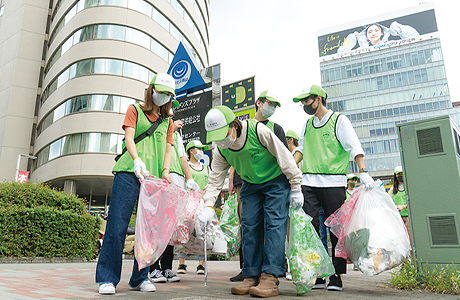 This is a good opportunity to restructure the university's role beyond research and education.
(Photo: Volunteer program "Green Up Project")
Searching for new forms of education amid the COVID-19 pandemic
Professor Miki Hasegawa, College of Science and Engineering Department of Chemistry and Biological Science
Not only at our university, but at universities with science and engineering faculties, experiments are almost compulsory. In such a situation, universities around the world were unable to hold face-to-face classes, and our university was also forced to hold online classes. However, faculty members and teaching assistants (TAs) worked together to maintain students' motivation by developing unprecedented classes, such as experiments using newly created video materials ("Inorganic Chemistry Experiments" first semester, specialized subject: on-demand format) and assignment creation through group work ("Inorganic Chemistry A" second semester, specialized subject: real-time format).
In addition, my laboratory, the Coordination Chemistry Laboratory, and a laboratory in Mexico started an online joint seminar immediately after the state of emergency was declared. We were able to share very meaningful moments, not only presenting and discussing our research but also introducing each other to our cultures.
Based on these experiences, I realized that the changes in university education are largely a paradigm shift in the use of ICT, and that they should be viewed positively.
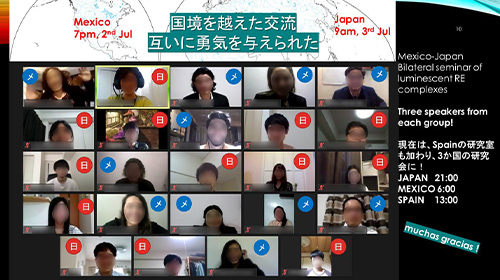 Online joint seminar with a Mexican laboratory
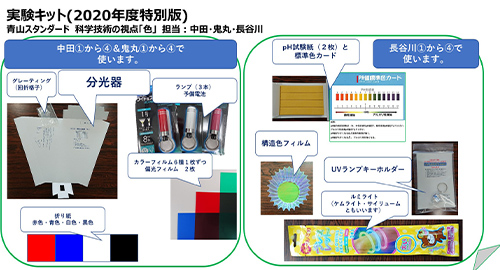 Experiment kit used in the "The Aoyama Standard" class