
Graduate School of Statistical Data Science * (tentative name)
Talking
*Planned to be installed in April 20272025. 12. 18
They have acquired a high level of expertise and a broad perspective across various fields.
Training data science professionals
The "Statistical Data Science Interdisciplinary Program (tentative name)," the first science-based undergraduate program Aoyama Campus, is planned for establishment in April 2027. This program will offer cutting-edge science education that systematically teaches statistics to tackle problems in the digital society, while providing a new interdisciplinary educational program that allows students to learn across five collaborating faculties. We spoke with President and General Manager the new interdisciplinary program's preparation office about the program's features and career paths after graduation.

INDEX
▼Dialogue General Manager President and the Director of the New Academic Program Preparation Office
■ Why is the first science and engineering undergraduate program Aoyama Campus called an "academic program" rather than a "faculty"?
■ What kind of learning will be offered in the new academic program?
■ What will students learn and what skills will they acquire?
■ Reasons for being based at Aoyama Campus
■ Differences from the Faculty College of Science and Engineering and School of Social Informatics
■ For those aiming for a degree in Statistical Data Science
 Dialogue between President and General Manager the New Academic Program Preparation Office
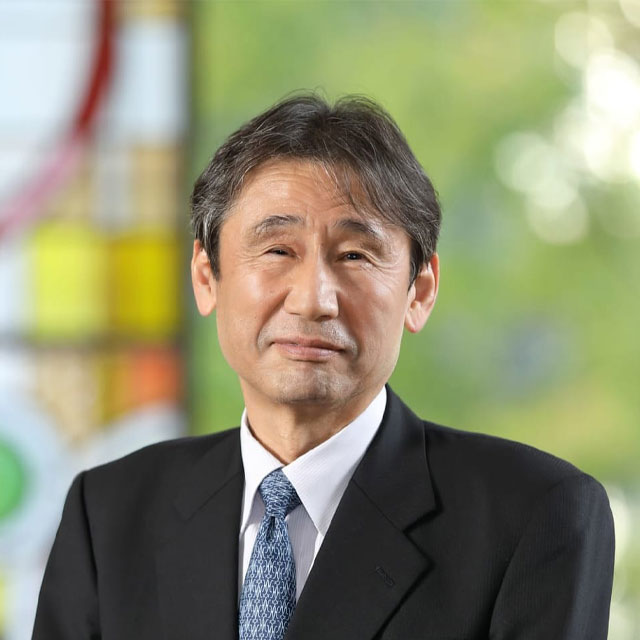
President
Professor, School of Social Informatics Department of Social Informatics
Hiroaki Inazumi
D. in Engineering (Waseda University). Graduate School of Science and Engineering Completed his master's degree in Mechanical Engineering at Waseda University in March 1984. He specializes in information theory, artificial intelligence, machine learning, and Japanese language education. Aoyama Gakuin University College of Science and Engineering After working in the Department of Industrial Engineering and College of Science and Engineering Department of Integrated information technology as an assistant professor, he became a professor there in 2003. 2004 College of Science and Engineering Director, Graduate School Graduate School of Science and Engineering Director. 2009 School of Social Informatics Department of Social Informatics Professor. 2010 School of Social Informatics Director, Graduate School Graduate School of Social Informatics Director. 2019 Vice President Director. 2023 Aoyama Gakuin University Appointed as the 20th President Director in December, 2023.
Assistant to President (Data Science)
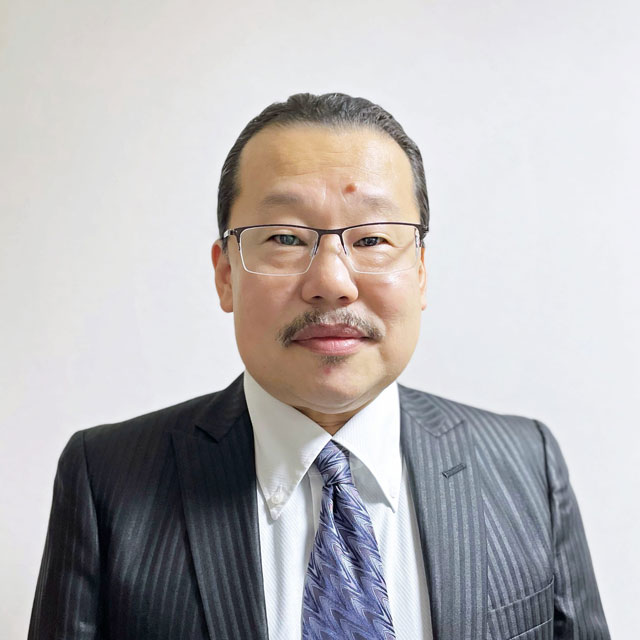
Professor, School of Business Department of Business Administration
General Manager the New Academic Circle Opening Preparation Office
Masuo Araki
Master of Economics (Aoyama Gakuin University). Completed the standard period of doctoral studies Graduate School of Economics at the Graduate School of Department of Economics Aoyama Gakuin University. Specializes in economic statistics and information education. Appointed as a full-time lecturer in the School of Business, Faculty Department of Business Administration Aoyama Gakuin University in 1999, and became a professor in 2010. After serving Chief of academic affairs for School of Business in 2020, became an assistant to the president in 2021, and was reappointed in December 2023.
Why is the first science and engineering undergraduate program Aoyama Campus called an "academic program" rather than a "faculty"?
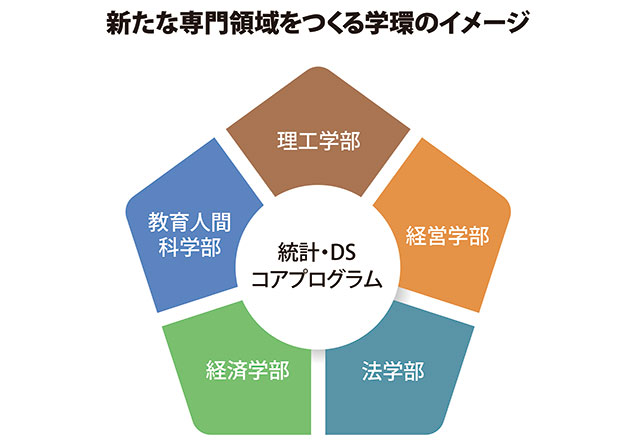
Inazumi: The "Statistical Data Science Graduate School (tentative name)," which is planned to be established in April 2027, aims to cultivate data science professionals needed in a data-driven society. It will be a small-scale undergraduate program with 60 students per year, specializing in statistics and data science, located on Aoyama campus. However, it will be a new educational program that allows students to learn across academic disciplines through the collaboration and cooperation of five faculties: College of Education, Psychology and Human Studies, the Faculty of College of Economics, the Faculty Faculty of Law, School of Business College of Science and Engineering, and the Faculty of Science and Engineering. Initially, we planned to establish a new "Faculty of Data Science," but in consideration of the university's message of wanting to provide both core learning and broad-ranging development, we decided to establish it as a "graduate school." Professor Araki, could you explain the background and circumstances surrounding this?
Araki: Initially, we were considering establishing a small faculty. However, we realized that it would be difficult for a single faculty to provide high-level data analysis and develop a broad perspective across various fields. On the other hand, looking within the university, we noticed that many faculty members were highly knowledgeable in data science. If we could secure cooperation from multiple faculties, it would be possible to create a system that provides specialized data science education while leveraging the expertise of each faculty. About a year had passed since we started thinking about the faculty, but we ultimately decided that the "Graduate School of Studies" format was the best option, and that's when we changed direction.
Even with the noble ideal of creating a new academic field within
our university to cultivate data science talent, establishing a new faculty would inevitably require a considerable number of students. In that respect, an "interdisciplinary program" allows us to seek knowledge and cooperation from faculty members of multiple collaborating faculties, and even with a small number of students, we can create a curriculum that aligns with the educational philosophy we had envisioned for the faculty. Thanks to five faculties—more than we had anticipated—stepping forward to become collaborating faculties, the interdisciplinary program concept became possible.
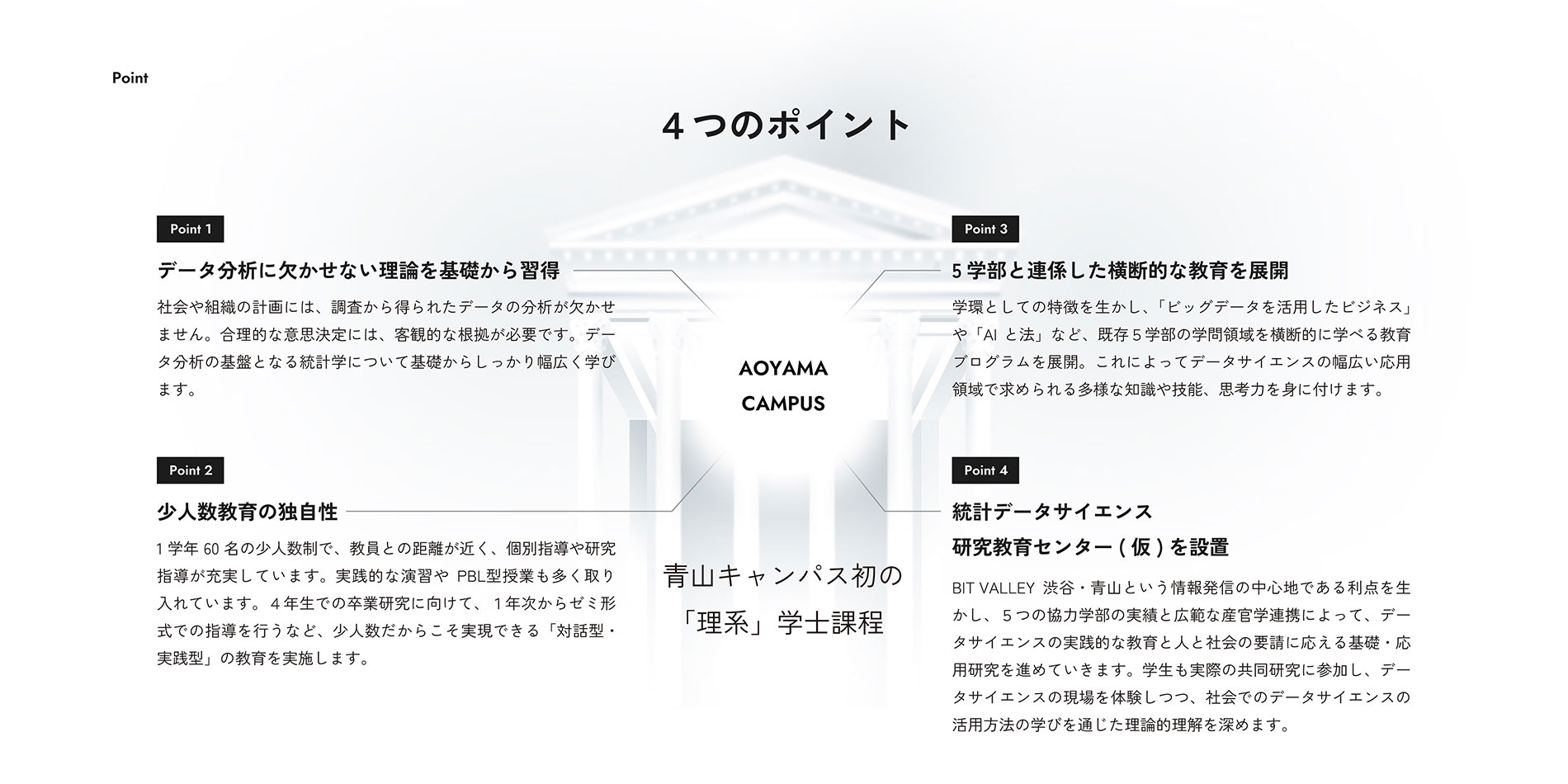
Araki: We are very grateful that five faculties, mainly faculty members who share our aspirations, have expressed their willingness to cooperate. Another important point was that forming an interdisciplinary program would allow us to create a small-group system where we can get to know every student. In data science, we conduct theoretical research, but practical research analyzing actual data is extremely important, and a system is needed where faculty and students can work together. In the Graduate School of Statistical Data Science, we have about 20 core faculty members for 60 students per year, but it is difficult to provide such attentive education and research in a faculty system. From this perspective, the interdisciplinary program is the best way to provide the data science education that our university aims for.
What kind of learning will be offered in the new academic program?
Inazumi: The most important thing is learning within the academic program, but what kind of approach is Professor Araki taking?
Araki's "cultivation of servant leaders" is the ideal profile that Aoyama cultivates, and it is the same in our Graduate School of Science and Technology. Moreover, the development of servant leaders is strongly linked to the training of data science personnel. At our university, we define a servant leader as "someone who serves others, discovers their mutual value, and creates a new era by connecting with other values." In increasingly diverse organizations, where different countries, cultures, and religions coexist, the ability to "listen" to everyone's opinions is required. All opinions and information that are listened to can be aggregated and analyzed as data, and connecting that to better solutions is data science itself. Therefore, I believe that education in our Graduate School of Science and Technology is equivalent to cultivating the ability to fulfill the basic mission of a servant leader. With this in mind, data science education can be said to be a field in which Aoyama 's educational philosophy can be put into practice.
Inazumi: Because our university has many students with a strong sense of balance and excellent intellectual communication skills, I expect that students studying in the Interdisciplinary Program will grow into "outstanding individuals" in the future. This means individuals who possess deep insight, can present ideas that differ from conventional thinking, and have the decisiveness to put them into action. In the Interdisciplinary Program, students cultivate the insight to see through to the knowledge behind the vast amount of accumulated data and the conditions of the fields in which the data is used. To achieve this, they thoroughly learn statistics and data science, which are the core of this program, and by actively incorporating the knowledge of collaborating departments, they acquire cutting-edge knowledge from the field side. This is by no means a benefit only for the Interdisciplinary Program; collaborating departments that provide specialized knowledge also benefit by developing the insight to interpret data. Ideally, a win-win relationship will be created through the Interdisciplinary Program.
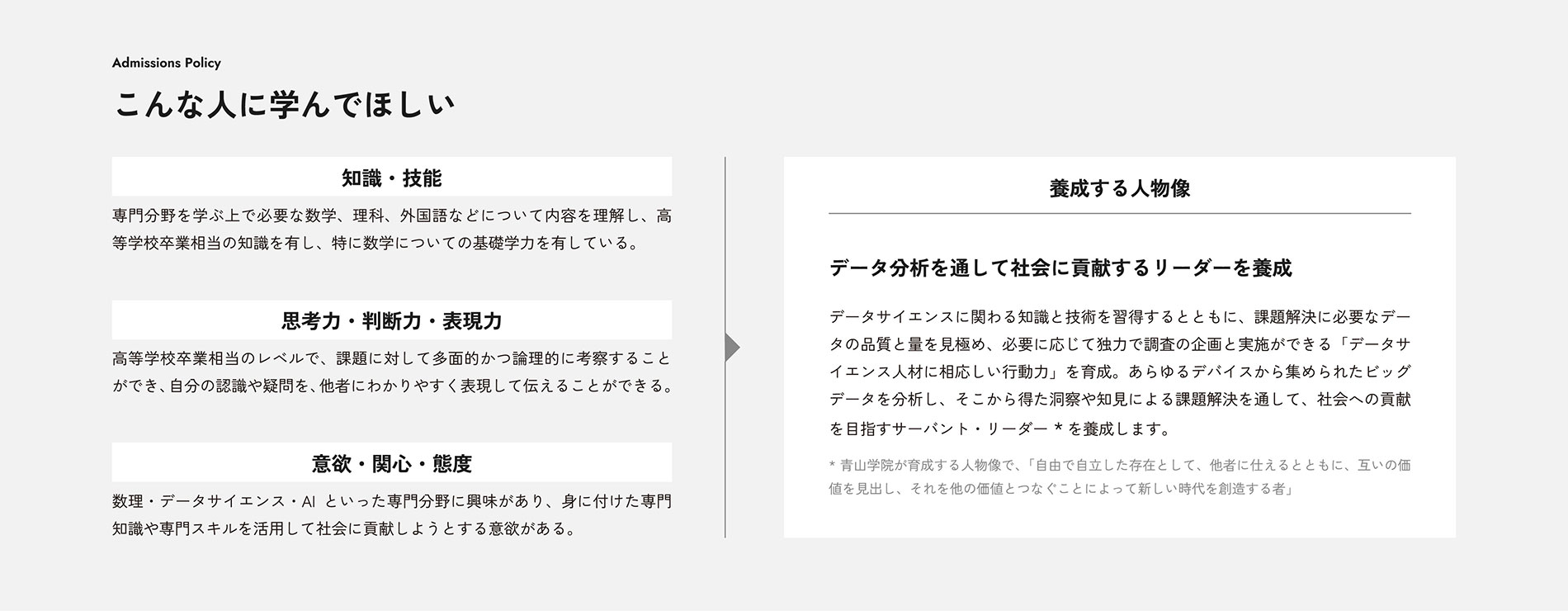
Araki: I have the impression that students at this university have strong communication and teamwork skills, so I agree with you that we want to cultivate outstanding talent in this program. By "outstanding," I mean someone who possesses advanced expertise in data science and a broad general education from collaborating faculties, and on top of that, the persuasive power to take unconventional strategies. Developing that persuasive power requires a certain amount of experience over time, so I want students to gain that supporting experience through practical research with faculty members. The small class sizes of this program allow for the close relationships that can be built with faculty members.
What do students learn, and what skills do they acquire?
Let's discuss the curriculum in more detail at Inazumi. The details are still under consideration, but please tell us what you know so far.
The greatest feature of this program is that while students specialize in
statistics and data science, they also acquire a broad general education from five collaborating faculties. In the specialized education provided by these collaborating faculties, students acquire scientific knowledge and skills related to programming and artificial intelligence, as well as legal expertise from faculty members of Faculty of Law who teach about copyright issues related to data used in AI. Similarly, they learn a wide range of general knowledge from the perspectives of education, economics, management, and science and engineering regarding data utilization, AI, and how to implement them in society, cultivating knowledge and skills in data science that are in high demand in various fields. The "Academic Network" is formed by bringing together the knowledge and educational know-how of the five faculties.
Inazumi: That's precisely the strength of the academic program.
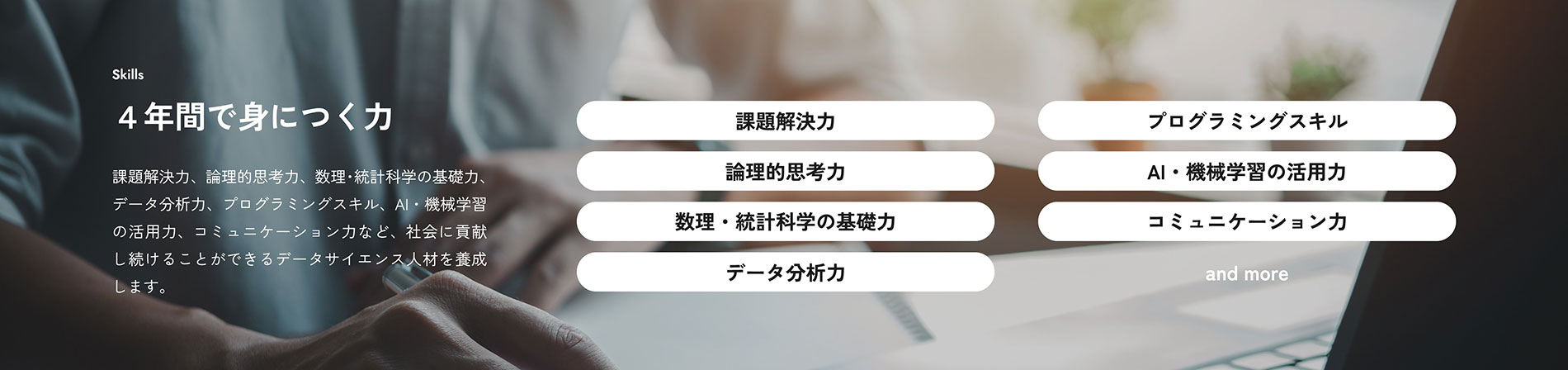
The Araki Interdisciplinary Curriculum includes the "The Aoyama Standard Subject Group," which provides a broad general education, as well as three unique subject groups specific to the Interdisciplinary Program. One subject is the "Interdisciplinary Program Common Subject," which cultivates the fundamental knowledge and skills essential for studying data science, and the mindset of a data science professional. This subject includes mathematics such as analysis and linear algebra, basic programming, and data science exercises. The other two subject groups, "Data Science Specialized Subjects" and "Statistics Specialized Subjects," provide specialized education in data science and statistics, respectively, and we aim for students to study both in a balanced manner. The "Data Science Specialized Subjects" include subjects such as unstructured data analysis using AI methods, programming, and AI ethics, which are likely to be familiar to those who hear the term "data science." On the other hand, the "Statistics Specialized Subjects" are subjects for studying statistics in depth, including theoretical subjects such as probability theory and mathematical statistics, as well as subjects that teach statistical methods such as various surveys. As can be seen from the fact that this Interdisciplinary Program has the word "statistics" before "data science," we also place importance on this aspect.
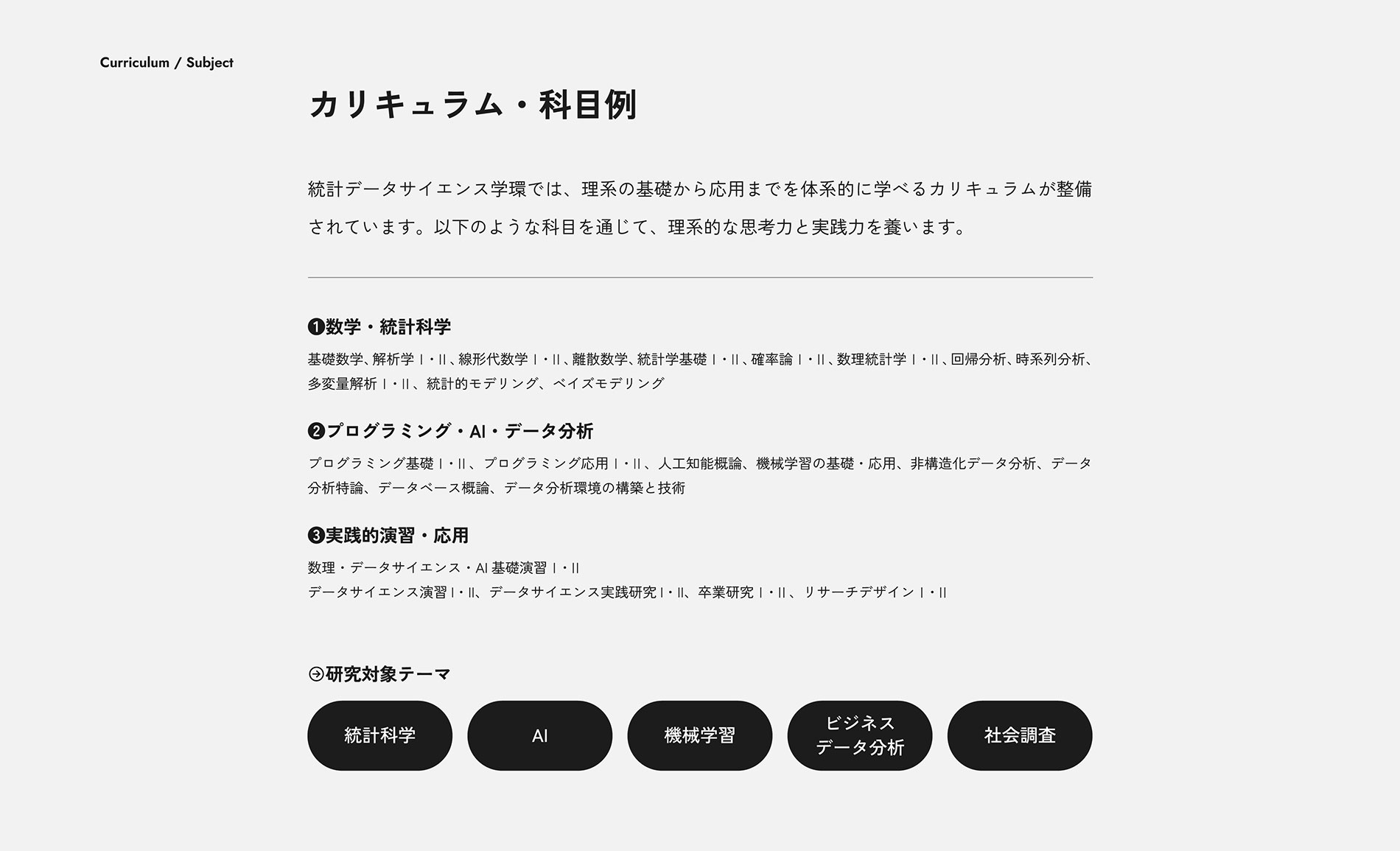
Inazumi In data science education, both theory and practice are naturally important, but I think the key will be how to design the balance between the two. We will need to think about how to incorporate exercises and how to build systems for collaboration with external organizations.
Araki Further learning opportunities could include, for example, a pathway for students who want to delve deeper into law and AI, allowing them to take Faculty of Law courses within the framework of elective subjects.
Inazumi That might be one of the great things about this interdisciplinary program. As an interdisciplinary program with five collaborating faculties, it offers a broader and deeper perspective than a typical data science faculty, but the main academic areas of this program are statistics and data science. Thanks to the development of many convenient tools these days, there is a drawback to thinking that programming and data analysis can be done easily. That is why the four years in this program are dedicated to thoroughly acquiring the knowledge and skills necessary to become a data science professional. On top of that, we hope that students will go on to graduate school or find employment in companies that operate globally, and that they will be able to spread their wings and solve various problems from a data perspective in a global environment.
Araki We also want to emphasize the importance of learning in an environment where students can immerse themselves in research, which is a characteristic of science and engineering disciplines. This will not only allow students to apply what they have learned to their research, but also motivate them to learn in order to acquire the practical knowledge necessary for research. To this end, we will establish a "Statistical Data Science Research and Education Center (tentative name)" and utilize it for education and research.
Inazumi If that's the case, then all the more reason to make it standard practice for graduates of the undergraduate program to pursue graduate studies.
Araki I agree. While the demand for data science professionals has increased significantly recently, allowing even undergraduate graduates to secure jobs at top companies, those with a master's degree will be able to demonstrate a higher level of expertise if they wish to truly excel in data science. Of course, career choices after graduation are ultimately up to the individual, but we strongly hope that graduates will pursue research all the way through to graduate school.
Inazumi Aoyama Gakuin University as a whole is moving in the direction of further enhancing its graduate programs, so we would really appreciate your cooperation.

Expected main paths
| Information and communications field | Data scientists and AI/machine learning engineers at web service and platform companies, etc. |
|---|---|
| Consulting and Marketing Fields | Value creation related to consumer behavior analysis, strategic proposals utilizing client company data, and think tank activities. |
| Finance and Securities Sector | Development of financial products, risk assessment related to assets, FinTech |
| Manufacturing and construction sectors | Planning and development of new products, quality control, and formulation of urban development plans. |
| Legal and Intellectual Property Fields | Legal research, legal tech fields such as AI contract review, and patent valuation. |
| Education and public sector | Developing new educational methods using AI, and addressing disparities caused by academic achievement gaps and multicultural backgrounds. |
| Graduate school admissions, researcher status, etc. | Application and improvement of existing methods through research, and proposal of new algorithms. |
Reasons for being based at Aoyama Campus
Inazumi When considering Aoyama Gakuin University as a whole, there is actually one more thing we are hoping for from this Graduate School of Science and Engineering. This also relates to the university's image in society, but the awareness that we have science and engineering faculties is not sufficiently high. College of Science and Engineering and School of Social Informatics are located on Sagamihara Campus, but with the establishment of the Graduate School of Statistical Data Science, the first undergraduate science and engineering program, on Aoyama Campus, we expect that there will be more opportunities for people to learn about our university's science and engineering initiatives. In addition, the university has tended to be primarily known for its humanities and social sciences brand image, but with the addition of science and engineering fields to Aoyama Campus, we expect to see an expansion into interdisciplinary fields across the entire university and... Sincere learning We hope this will contribute to the further advancement of "[the program/series name]" and the creation of a new Aogaku brand.
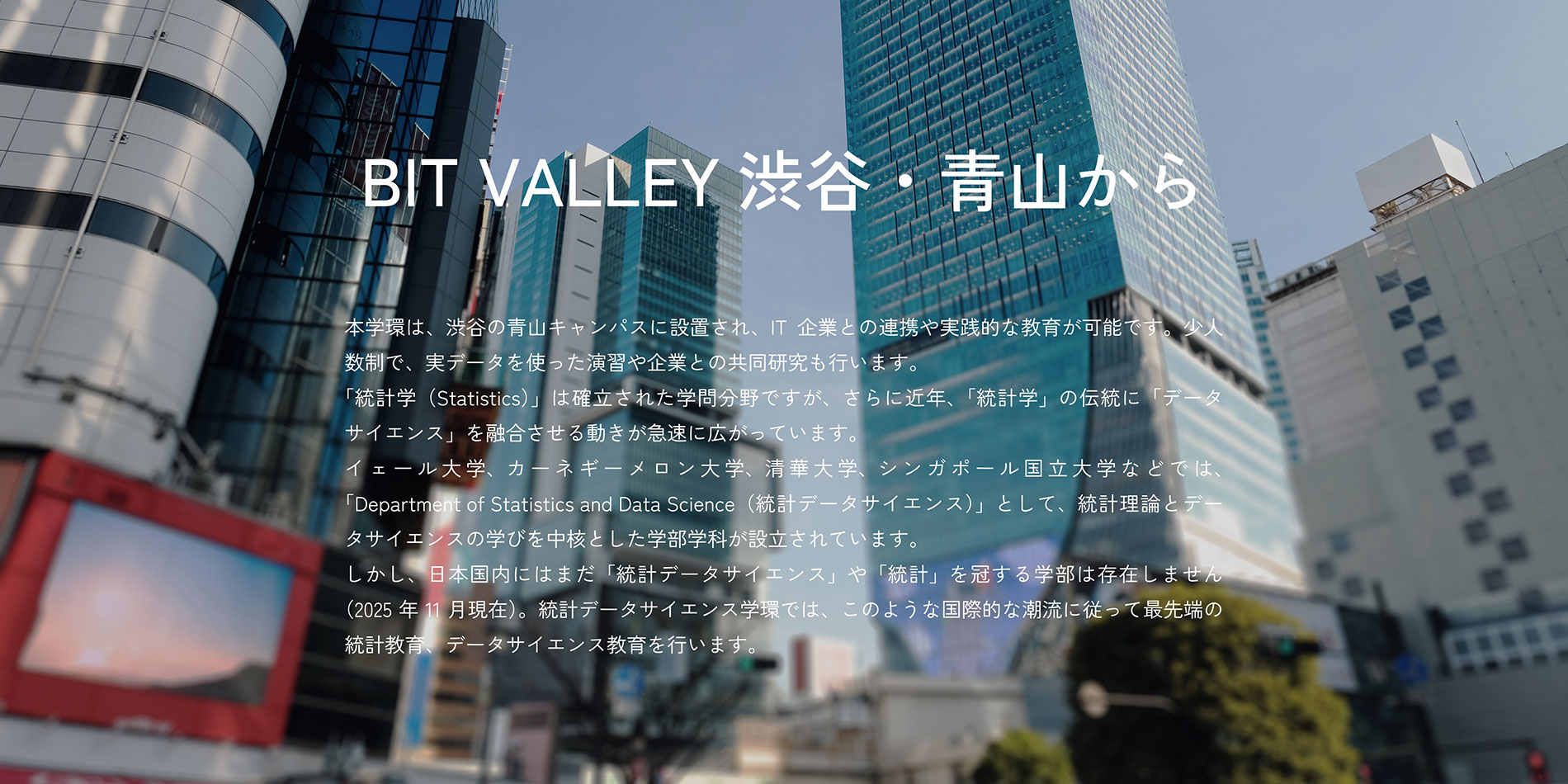
Araki For the field of data science, the advantages of being located on Aoyama campus are considerable. Our program involves analyzing real-world data in our classes, making collaborative and commissioned research with companies and other organizations essential. Having companies and government offices nearby is crucial for this. Sibuya Ward, where Aoyama campus is located, is home to "BIT VALLEY," a hub that has produced many IT ventures and served as a starting point for the development of the ICT industry. * This makes it easier to build relationships, and if our interdisciplinary research center on Aoyama campus becomes a key station for collaborations with companies and government agencies, it will be easier to create opportunities for joint research with the Faculty of College of Science and Engineering Engineering, with which we have a collaborative relationship. Furthermore, faculty members from the Faculty of College of Science and Engineering can conduct joint research with companies and other organizations on Aoyama campus and bring the results back to Sagamihara campus in terms of education and research.
*This term was coined in the late 1990s, combining "bitter" from Sibuya, "bit" (a unit of information), and "valley," inspired by "Silicon Valley," a hub of IT ventures in San Francisco, USA. In recent years, it has been revived through projects such as the "BIT VALLEY" project.
Inazumi This means that our academic program will function as a hub for businesses and government agencies by being based at Aoyama campus. Leveraging the advantages of Aoyama campus location is extremely important to our university's strategy.
Araki The establishment of a data science hub on Aoyama campus will likely be beneficial in enhancing recurrent education and lifelong learning in the future. As AI and other technologies continue to advance, it will serve as a place for business professionals, including alumni, to catch up on their skills and technologies, strengthen their sense of belonging and loyalty to Aoyama Gakuin University, and foster a diverse group of generations from different fields to learn together, which will be a positive development for the university in the future.
Inazumi Indeed, data science has a very high affinity with programs for working professionals. Offering a wide range of educational programs, including adult education, is particularly valuable in this location.
Differences from College of Science and Engineering and School of Social Informatics
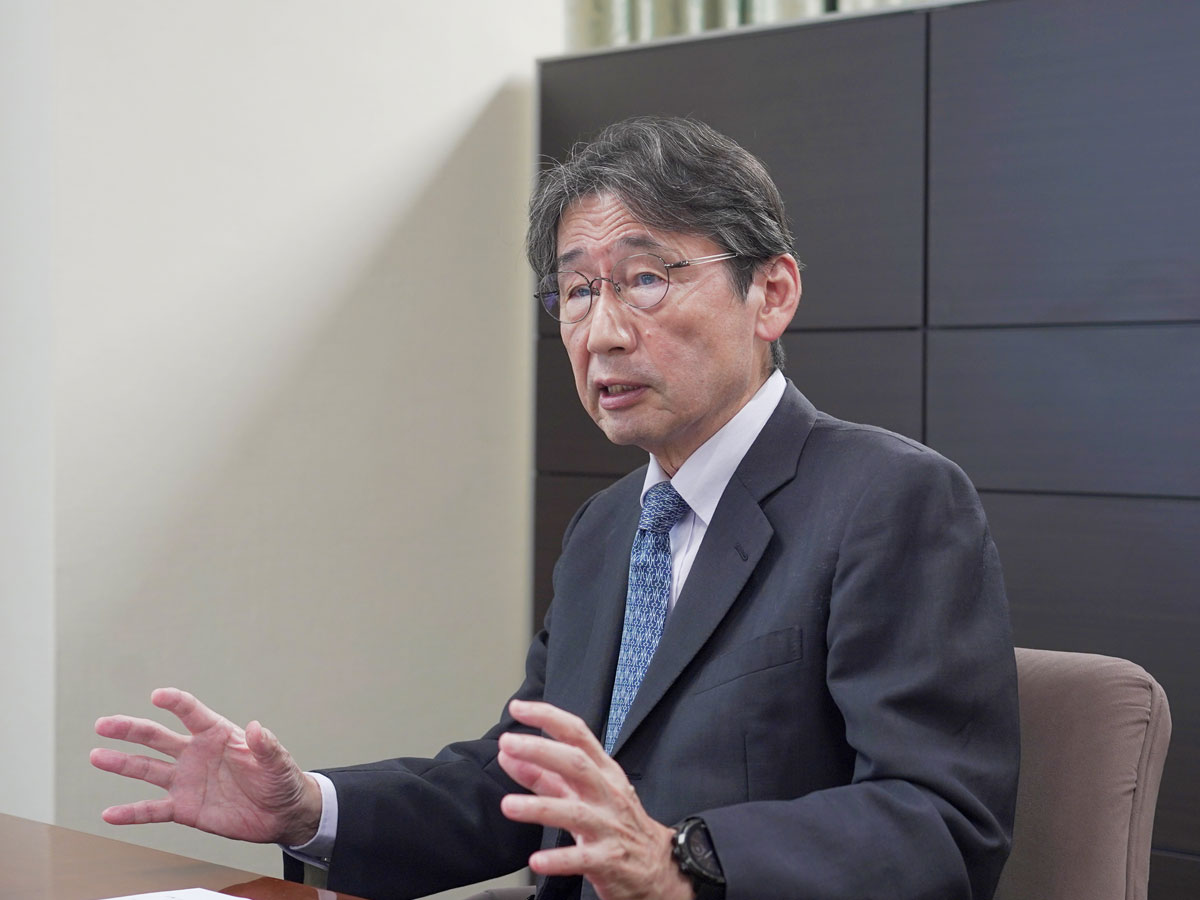
Some people have asked how the Faculty of Science and College of Science and Engineering and School of Social Informatics, which are science-based faculties, are differentiated from the Graduate School of Statistical Data Science. President Inazumi is also a professor in School of Social Informatics, so how would you answer that question?
While School of Social Informatics, College of Science and Engineering, and the Graduate School of Statistical Data Science may appear to be rivals, their content is distinctly different. First, regarding the difference with the Faculty of Science and College of Science and Engineering, the Faculty of Science and College of Science and Engineering has a curriculum in which students acquire all the fundamentals of physics, chemistry, and engineering before moving on to their respective specialized fields. In contrast, the Graduate School of Statistical Data Science does not build upon a foundation of science, but rather has a curriculum that is strictly specialized in data science, with the knowledge of collaborating faculties positioned as a subspecialty. The relationship is that College of Science and Engineering and Engineering teaches fundamental science in general, while the Graduate School of Statistical Data Science specializes in data science.
Araki: Yes, I think the difference between the two is clear.
At
Inazumi, School of Social Informatics certainly shares some similarities. In School of Social Informatics, students with both humanities and science orientations study in an interdisciplinary manner, and the curriculum includes introductory courses on data science. However, while there are developments in the information field such as system analysis and design and application development, students also study humanities and social science subjects such as psychology, economics, business administration, and education. Looking only at the subjects, School of Social Informatics and our university's interdisciplinary program seem similar, but the purpose of learning is different. Social informatics is an interdisciplinary field of study that researches the relationship between information (symbols, data, knowledge, and meaning) and people and society, while data science is a science-based field of study that focuses on data (numerical values, text, images, logs, etc.) as the research subject and specializes in extracting knowledge from data, and this is where the difference lies.
Araki: I think the differences are easier to understand if you consider the entrance exam subjects. High school students are mainly divided into humanities and science streams when studying for entrance exams, so humanities students don't take entrance exams for science-related faculties or departments. In the case of our university's general entrance exam, the entrance exam subjects for the Graduate School of Statistics and Data Science are mainly science-related mathematics, but School of Social Informatics offers various methods, such as a method that requires mathematics or a method that allows applicants to take the exam with only humanities subjects such as Japanese language and social studies. I think that difference is significant for applicants.
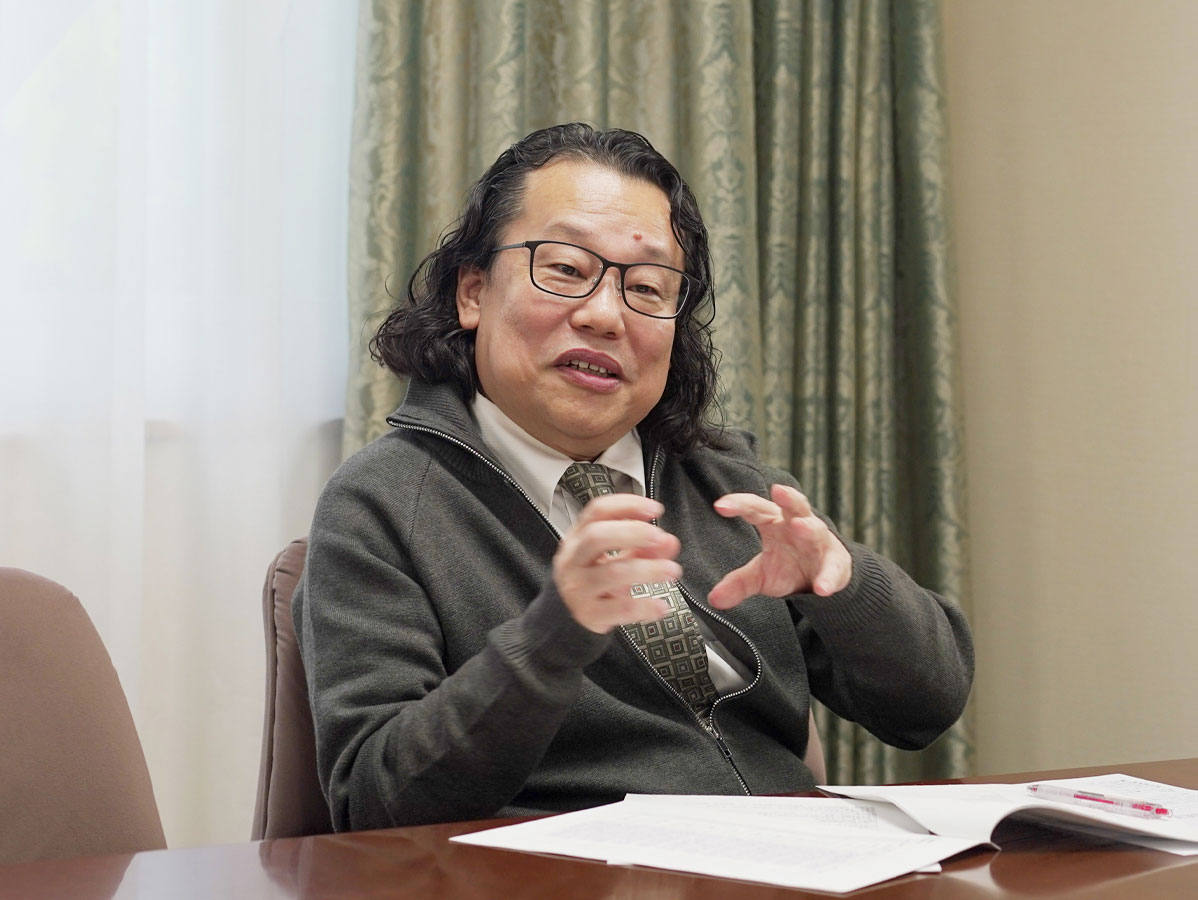
The difference between School of Social Informatics and the Graduate School of Statistical Data Science can be understood by considering their respective work styles. The Graduate School of Statistical Data Science provides education that equips students with the data analysis skills necessary to become specialists with in-depth knowledge of industry and company data in organizations such as manufacturers, trading companies, and government agencies. On the other hand, School of Social Informatics has a curriculum designed to cultivate individuals who possess a certain level of knowledge of networks and web services, as well as the ability to perform project management and system design, for use in organizations such as manufacturers, trading companies, and government agencies.
For those aiming for a graduate program in statistics and data science
Inazumi If you were to highlight the positive aspects of the new school program, primarily to parents, what would you say would be the key selling points?
Araki A major advantage is the small class sizes, which allow students to receive detailed support from faculty members during lectures and practical exercises. In addition, we have a team of supportive faculty members who can provide thorough assistance with job hunting and career paths. We are also considering establishing a graduate school, so we would recommend that students pursue further studies. In graduate school, students will engage in theoretical research at a level that cannot be covered in undergraduate programs, such as developing algorithms and estimation methods, and conducting research to improve estimation accuracy. It is also possible to obtain patents based on such research results, which would significantly increase the market value of the work. Graduate students have significantly more opportunities for collaborative research with companies, so we would like you to consider graduate school as a career path after graduation.
Inazumi That's a really important point. At our university, more than half of the graduates from the Faculty of College of Science and Engineering go on to graduate school, and about 90% of those who complete the master's program find employment in companies.
Araki If we can leverage the advantages of our Aoyama campus to conduct collaborative research with companies and research institutions that students admire, and then have graduates who go on to join those organizations and thrive based on that experience, they will serve as role models for their juniors. We faculty members must create a system that enables such collaborative research with companies.
Inazumi Aoyama Gakuin University is a university that produces energetic and vibrant students, some of whom start their own businesses and thrive while still enrolled, others who excel in large corporations, and still others who spin off from large corporations to forge their own paths. We hope that graduates of the Graduate School of Statistics and Data Science will make their presence felt within this environment. Furthermore, we want them to become an inspiring presence for students in the humanities faculties on Aoyama campus, and we will provide the learning opportunities to enable them to do so.
High school students and prospective students interested in Arakimoto's academic program should start paying attention to the data they encounter in their daily lives. One way to do this is to look at graphs and tables in newspaper and web articles and try to interpret what you can learn from them in your own way. Then, compare your interpretation with the explanatory text about the graphs and tables written in the article. It's okay if your interpretation isn't exactly the same as others. Having opposing opinions or questions, such as "This way of thinking is different from mine," is proof that you have developed a desire to interpret something from data, and I think that shows you are quite well-suited to this academic program.
 For high school students and prospective students aiming for a graduate program in statistical data science, it is recommended that they try to interpret what they can learn from graphs and tables in their own way.
Inazumi: Following this line of thought, the keyword is "Why." If you're someone who asks yourself "Why?" and lives your life with that kind of awareness, then I'd love for you to join us in this academic program.
Outline of the plan to establish the "Graduate School of Statistical Data Science"
| item | Content |
|---|---|
| classification | Establishment of a basic organization for implementing interdisciplinary courses. |
| campus | Aoyama Campus (Years 1-4) |
| Opening period | April 2027 |
| Degree awarded | Bachelor of Science (Data Science) |
| Degree field | Engineering-related (planned) |
| Collaborative Faculties | College of Education, Psychology and Human Studies, College of Economics, Faculty of Law, School of Business, College of Science and Engineering |
| Capacity | Enrollment capacity: 60 students, total capacity: 240 students |
| Core faculty | About 20 people |