Required subjects
"Introduction to Christianity" and
Through worship services,
Understanding the Academic Mindset 2026.4.9
Christian Education at Aoyama Gakuin University in the Modern Age
Since its founding, Aoyama has based its education on Christian faith. This article will introduce the significance of Christian education at our university and the message conveyed through "worship services," the required course "Introduction to Christianity I," and other Christian-related subjects and activities. We will also address the key points for understanding the differences between our university and "Christian cults," which should be avoided.

INDEX
▼ Christian activities at our university (Interview with the Head of the University's Religious Affairs General Manager)
[1] The Significance of Christian Education
(1) What are the ideas of Christianity?
(2) "Salt of the Earth, Light of the World" and "Servant Leader"
[2] The pillars of Christian education
(1) Worship
(2) Regular subjects related to Christianity
① Introduction to Christianity
② Service-Learning
③ Soper Program
(3) Christian activities
[3] A Christian message that transcends time and resonates with students living in the present.
▼ [Warning] Differences from Christian-based new religious movements
▼ Our Christian Activities (Student Voices)
■ Aoyama Campus: Learning as a source of emotional support; finding inner peace and expanding new perspectives in the chapel.
■ Aoyama Campus (Self-funded International Students): Finding the ability to understand the world and a place to belong in Japan
■ Sagamihara Campus: Unraveling the Modern World and Yourself Through the Bible - The Chapel of Light Connects You to the World
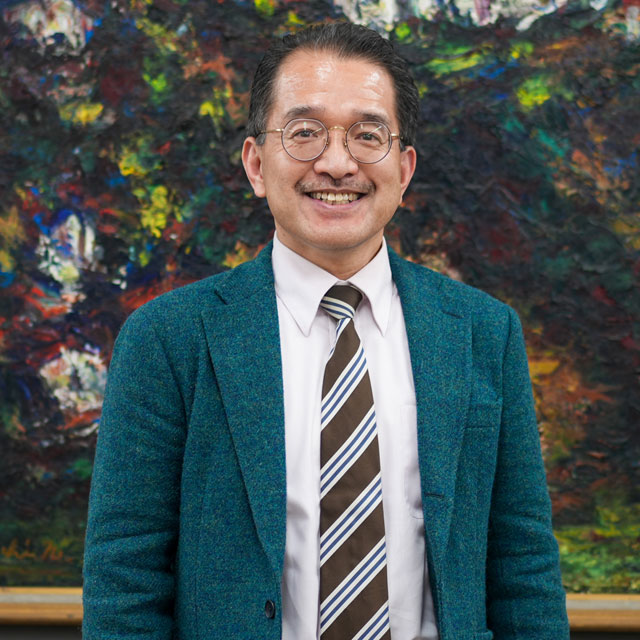
Christian Activities at Our University (Interview General Manager Religious Affairs)
University Religious Affairs General Manager
Professor, School of Social Informatics
Ken Omiya
He graduated from College of Economics Keio University. He completed the Master's program in Theology at the Graduate School of Theology, Tokyo Union Theological Seminary. He holds a Master of Theology degree from Tokyo Union Theological Seminary. After working at Nikko Securities Co., Ltd., serving as pastor at the Nishinasuno Church and Zushi Church of the United Church of Christ in Japan, he became the university's Chief of Religious Affairs and Associate Professor School of Social Informatics Aoyama Gakuin University University in 2008. He became a professor at the same university in 2019. He has been the university's General Manager of Religious Affairs since 2023.
[1] The Significance of Christian Education
(1) What are the ideas of Christianity?
Aoyama was founded in the early Meiji era by the Methodist Episcopal Church in the United States. * Founded by three missionaries sent from [location] Three schools as its origins It states that "Aoyama 's education must forever be based on Christian faith." Aiming for education based on Christian faith, the university's "Educational Policy" states that it aims to "cultivate individuals who live truthfully before God, humbly pursue truth, and willingly fulfill their responsibilities to all people and society with a spirit of love and service."
*Methodist Episcopal Church…A Protestant Christian denomination founded in England by John Wesley (1703-1791) and developed in the United States. The statue of John Wesley is on the outer wall of Building 14 to the right of Main Gate of Aoyama campus. The chapel at Sagamihara campus is also named Wesley Chapel.
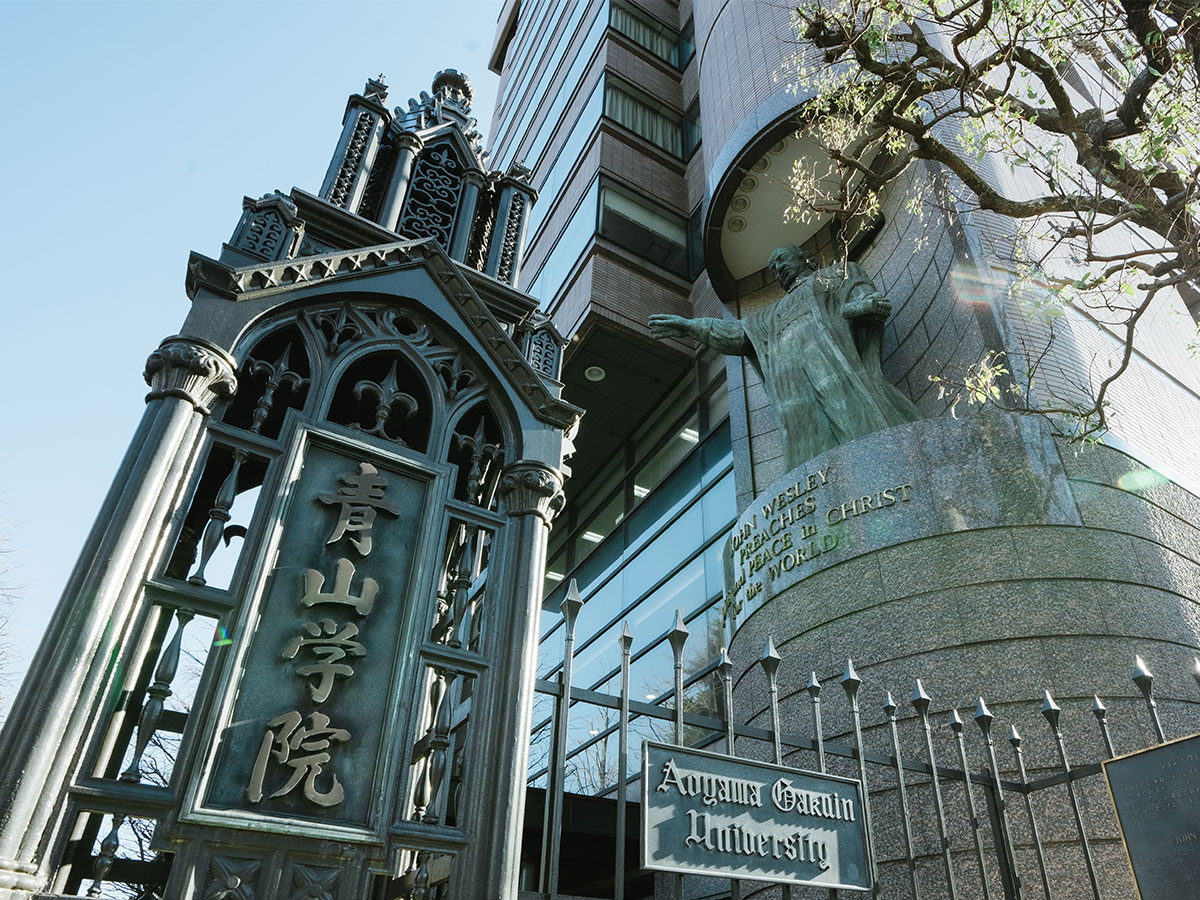 The John Wesley statue is a bronze sculpture measuring 4.25 meters in height and weighing 1.7 tons. He holds a Bible in his left hand and offers a benediction with his right hand. (Created by Professor Emeritus Hiroshi Kojima, College of Literature)
To reiterate, what are the core beliefs of Christianity? Let's look at some representative examples.
First and foremost is the idea that "each individual is an irreplaceable being." The central message of Christianity is that "God created the world, including humanity, and loves all that lives in it." It is believed that each human being is a precious being created by God, and that their very existence has value. God's love is called "agape" in Greek, and agape is given unconditionally and without expectation of anything, regardless of gender, race, achievements, or even whether or not a person has faith. By having a shared understanding that "every human being is cherished by God, no matter who they are," a spirit of cherishing both oneself and others is nurtured.
Another characteristic of Christianity is the belief that "everyone is born with their own unique and wonderful abilities." This is because the Bible states that "God entrusts each and every person with wonderful talents." Therefore, Christian education is not based on the idea of "teaching knowledge and skills from scratch to people who have nothing," but rather on the idea of "drawing out the talents that each person possesses." The word "talent," which refers to abilities and talents, originally meant a unit of currency, but in the parable of the talents in the Bible, where this word is a key word, a servant who increased his wealth by trading with the property (talents) entrusted to him by his master is given even more, but a servant who did nothing out of fear of failure is rebuked. This parable shows the importance of humans trusting in God, their master, and taking on challenges using the talents entrusted to them by God without fear of failure. And, as this teaching shows, the talents given to each individual are expected to be used to the fullest for the benefit of society.
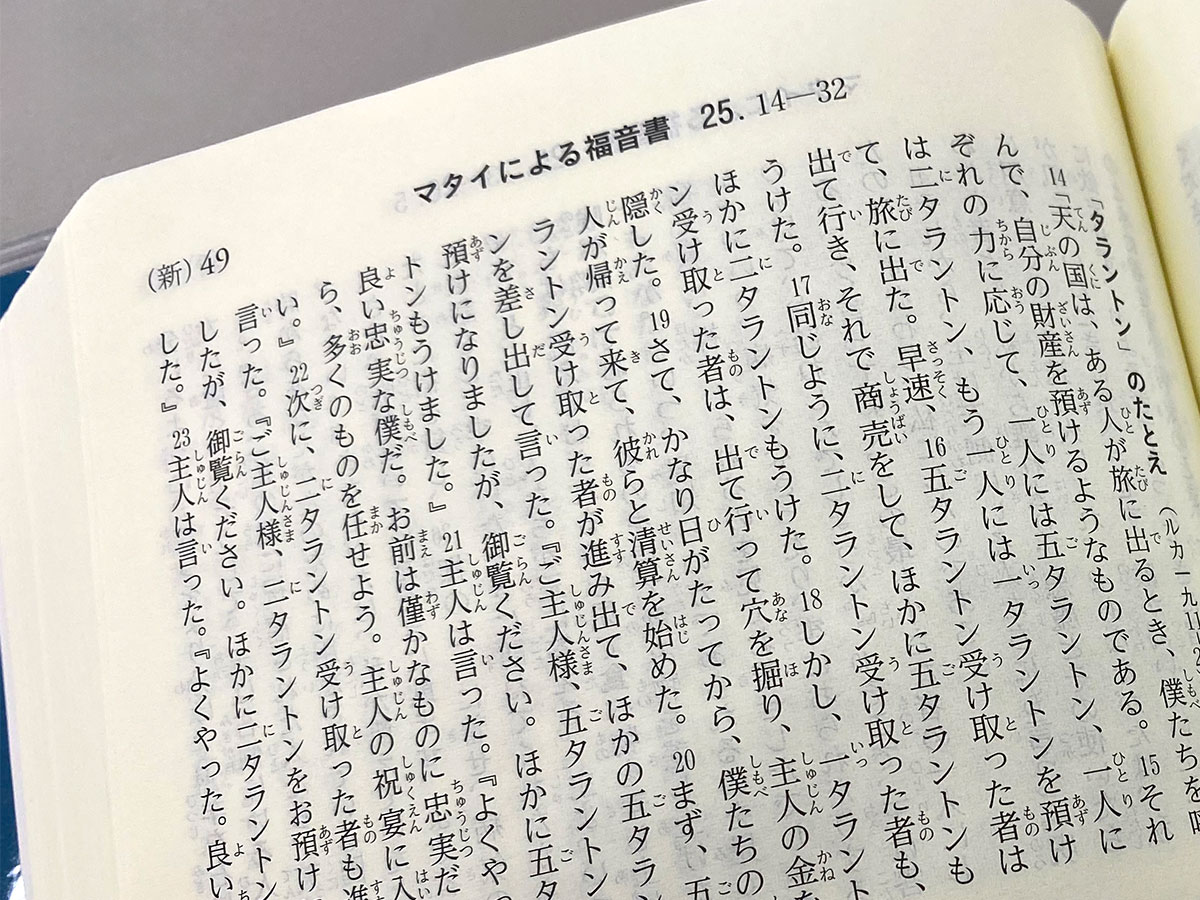 The parable of the "talent" found in Matthew 25:14-30 (The Bible, Common Translation of the Bible Society)
© Japan Bible Society
Furthermore, Christianity is characterized by cherishing each individual's talents as gifts from God and respecting the diversity of each person. It emphasizes the idea of "being both A and B" rather than a binary choice of "A or B." For example, in Christianity, Jesus Christ is believed to be "the true God and the true man." In our society, too, we often find ourselves saying things like, "That person is serious but also funny," or "(Regarding a certain event) people have different perspectives, but I can understand both sides of the argument." Multifacetedness can be described as a state where there are multiple yardsticks, rather than evaluating and dismissing someone based on a single standard such as "can do/cannot do something" or "is it valuable to someone/is it not valuable to someone." An important aspect of Christian education is that we learn to recognize that "this person has their own good points," rather than judging different personalities as good or bad.
(2) "Salt of the Earth, Light of the World" and "Servant Leader"
Furthermore, at our university, we cherish the phrase "salt of the earth and light of the world" found in the New Testament, Matthew 5:13-16, and the concept of "servant leadership." Salt acts as a preservative, preventing the corruption of people and society. Light warmly illuminates lonely individuals while also illuminating injustice and revealing truths. The Bible says, "You are the salt of the earth," and "You are the light of the world," but what is important here is that for human beings, being "salt of the earth and light of the world" is not a "goal to strive for" but a "certainty." It is a phrase that encourages action, saying, "You are already the salt of the earth and light of the world, so fulfill your roles." This phrase expresses a deep trust in humanity, similar to the "parable of the talents" mentioned earlier, and is expected to help students break free from negative beliefs such as "I'm useless." After hearing this, some students commented, "The 'already' part made me feel relieved, as if my own worth was being acknowledged," and "It motivated me."
Those who embody this "salt of the earth, light of the world" are "servant leaders." A servant leader is someone who serves society while exercising leadership, and is therefore not "just a convenient person." For this reason, they need to continuously refine the knowledge, skills, experience, and character befitting a leader.
[2] The pillars of Christian education
(1) Worship
Based on these ideas, the three pillars established to realize Christian education at this university are "worship," "regular subjects related to Christianity," and "Christian activities."
Worship is a visible manifestation of faith and a central forum for conveying "what our university values in Christian education." Therefore, in addition to regular university worship services, we conduct major ceremonies, including the entrance ceremony and the degree conferment ceremony (graduation ceremony), in the form of worship services.
Major ceremonies at our university are designed to allow all attendees to participate while maintaining their own religious, cultural, and spiritual backgrounds. This embodies our university's inclusive spirit of welcoming people with diverse values and cultural backgrounds. There is absolutely no pressure to convert to Christianity.
Worship services typically begin with a pipe organ prelude, followed by hymns, Bible readings, a sermon, prayer, and a postlude. The preacher is usually the university's religious Chief or a church pastor. Sermons cover the contents of the Bible and important Christian concepts, but the approach varies greatly depending on the preacher. You can absorb various things from the sermon, and if you have something weighing on your mind, you can take a breather and rest your heart in the calm atmosphere of the chapel. Worship services are also effective when you want to "cleanse your soul" with sunlight. Each faculty and Professional Graduate Schools has faculty members who are qualified pastors (university religious Chief) or missionaries, so you might discover something new by talking to them outside of worship services and classes.
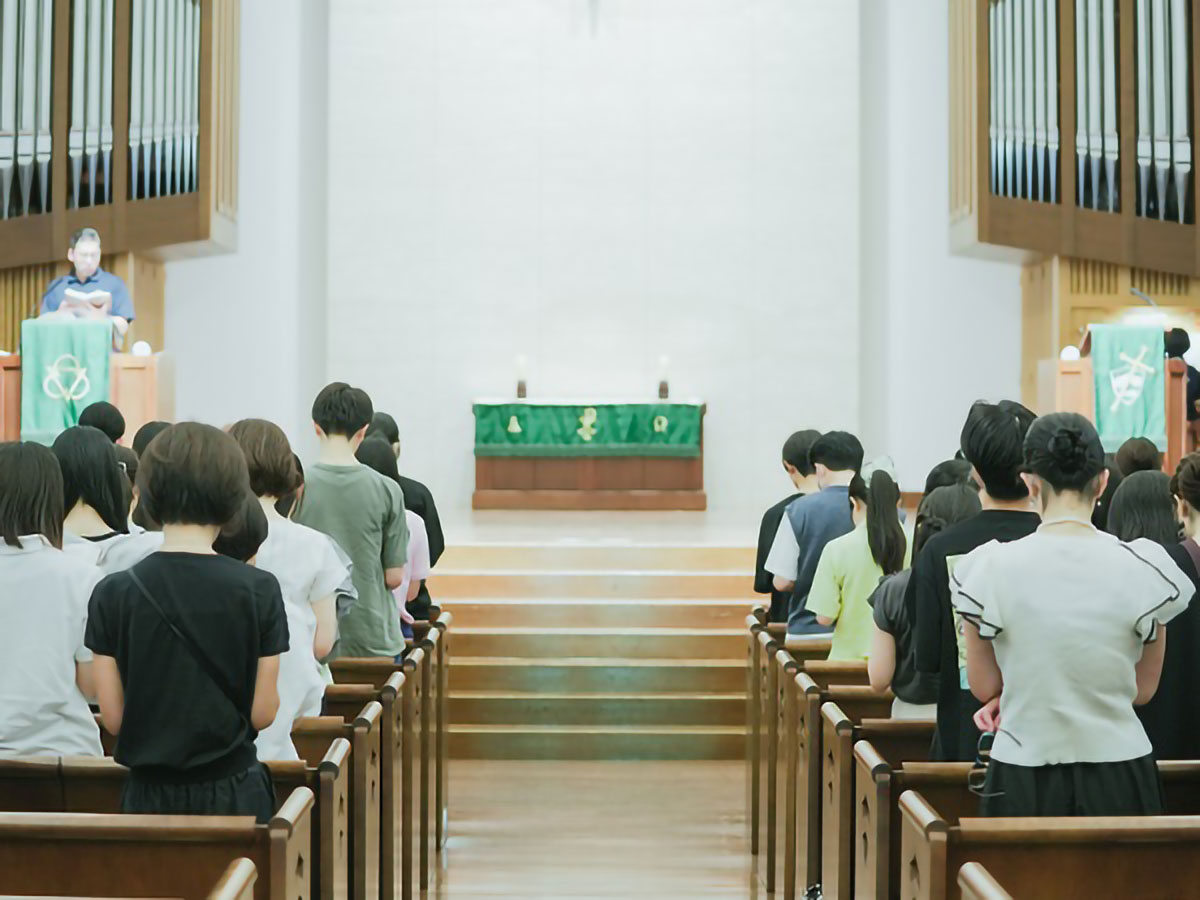 Open campus welcome service. Singing hymns accompanied by pipe organ music.
One thing I'd like to mention here is that at our university, the send-off and victory celebration for the track and field club (long-distance block) in the Hakone Ekiden, as well as the victory celebration for the baseball club, begin with an opening prayer by the religious Chief in front of the chapel on each campus. It's always a pleasure when, after leading the opening prayer, baseball players running around campus during practice come up to greet me. One particularly memorable experience was when I offered a prayer at the unveiling ceremony for a plaque commemorating the 2,000 hits achieved by alumni Toshihito Iguchi and Hiroki Kokubo (current manager of the Fukuoka SoftBank Hawks). A graduate who attended told me that it reminded him of the hardships he faced in the baseball club. It was very impressive to see that he listened carefully to the words of prayer and connected them to his own experiences.
(2) Regular subjects related to Christianity
① Introduction to Christianity
Another pillar of Christian education is the Christian understanding-related subjects, including the compulsory course "Introduction to Christianity I." "Introduction to Christianity I and II" aim to deepen students' understanding of Christian thought by providing them with a foundational knowledge of the Bible.
For example, in my first-year course, "Introduction to Christianity I," I use the "World Religion Distribution Map" (source: "Christian Yearbook 2024-2025," Christian Newspaper Company) to introduce the role of religion around the world. First, Christianity is the world's largest religion, with believers accounting for approximately 33% of the world's population. Adding Islam, Hinduism, and Buddhism to this, the four major religions alone account for approximately 77% of the world's population. There are many other religions in the world, so overall, those with no religion are a minority. Against this backdrop, I introduce how religion is a lifestyle and the foundation of moral values for many people around the world. Furthermore, Christianity is deeply intertwined with various fields around the world, from economics and art to daily life. Therefore, I also convey that learning about Christian knowledge and ways of thinking is of great significance from a general education perspective.
Furthermore, the course will touch upon the history of our university, the missionaries who worked hard to establish the school, and other collaborators. While there will be a report assignment on worship services, this is intended to allow students to learn about Christianity in a practical setting and is not intended to encourage conversion. Through this course, we hope that students will deepen their understanding of the ideas, logic, and values of Christian faith that have been passed down through generations at Aoyama.
Related video: [Student-led course introduction video] Learning from the "The Aoyama Standard" / Introduction to Christianity I
② Service-Learning
Another course that best exemplifies the characteristics of Christian education is "Service Learning." This program allows students to apply the knowledge and skills they acquire in the classroom to activities aimed at solving various problems in their local communities, thereby fostering a sense of "civic responsibility" and "the role they play in society." Service Learning consists of three elements: lectures by guest speakers invited from civic activity groups, NPOs, and social business companies; volunteer activities conducted by the students themselves; and post-activity learning and presentations. The locations where students participate in these activities range widely, from within Japan to the Philippines and Cambodia.
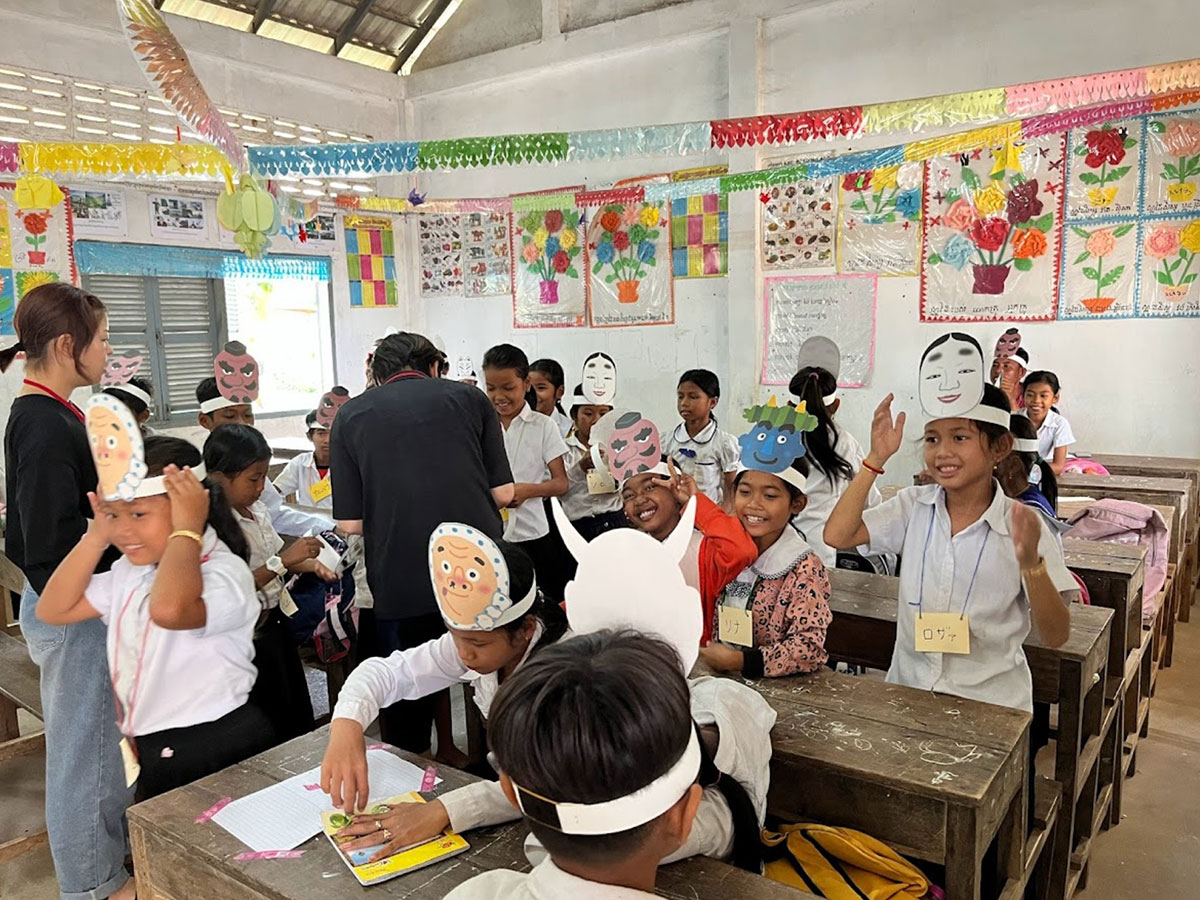 "Service-Learning III" (A class introducing Japanese culture at a free school in Cambodia)
In service-learning, we emphasize fostering a sincere attitude of learning from reality by having students listen to firsthand accounts from those who continue volunteer activities and by having them participate in hands-on activities themselves. By witnessing the complexity of social issues, students can move beyond theoretical discussions and gain a more realistic perspective. It is also a valuable opportunity to practically learn about diverse ways of thinking, acting, and living, as well as servant leadership. We hope that this class will serve as a catalyst for students to think about "what they can do."
③ Soper Program
Another unique subject at our university is the "Soper Program." This program is designed for students aiming to become teachers at Christian schools and offers a comprehensive set of specialized subjects. The program completion certificate is a valuable asset for students hoping to be employed at a Christian school. Approximately 10 students complete the program each year, and several of them actually become teachers at Christian schools.
In addition to the The Aoyama Standard courses, our university offers many other courses related to understanding Christianity, including art, history, politics, philosophy, and ethics. In every class, there is a wish that students keep in mind the fact that "everyone is created in the image of God and is a precious and irreplaceable being with dignity," as stated in a passage from the Book of Genesis: "God created mankind in his own image, in the image of God he created them; male and female he created them."
(3) Christian activities
For more information on our Christian activities, which are another pillar of our organization, please refer to "Our Christian Activities (Student Voices)" below.
[3] A Christian message that transcends time and resonates with students living in the present.
Many students at our university have never been exposed to Christianity before enrolling, so before learning about Christianity through classes and worship services, they often have the misconception that "this has nothing to do with me" or feel a certain tension. However, after learning about it, those feelings fade, and I think many students come to understand that "even though the Bible is an ancient document, it contains messages that resonate with us living in the modern age." When we covered the miracle stories of Jesus Christ in the New Testament, one student wrote on their response sheet that "more than the extraordinary nature of the miracles, I was encouraged by the image of Jesus Christ reaching out to people in distress."
Whether you are a Christian or not, I believe there is much to be learned from Christianity, which has been passed down for over 2,000 years, as guidance for life. At our university, we aim to deliver the message of Christianity, which still holds great value in today's world, to as many students as possible through Christian education.
The Christian God is essentially love. I sincerely hope you will have a wonderful university life in an environment that values love.
[Warning] Differences from Christian-based new religious movements
Having the option to "distance"—the boundary between safe faith and dangerous temptation
university religion Chief Naoya Shiotani It's difficult to simply describe the difference between the Christianity that Aoyama believes in and a "Christian-based new religious movement (cult)." This is because the objects of worship and doctrines of both are often almost identical. Rather, the important point is that, regardless of what kind of group it is, When you sense danger, leave without hesitation. This is the kind of literacy required. So, what kind of organizations are "dangerous"?
① To approach rapidly. They are extremely friendly and will quickly close the distance between you. They walk the fine line between being overly familiar and being overly kind, which can make it difficult to judge their intentions. However, good wine and friendship take time to develop. Be cautious of rapid progress.
② To tire someone out. The fun activities and learning opportunities keep coming one after another, giving you no time to stop and think. That's because if you think slowly, their true identities will be revealed.
③ They dislike ambiguity. Cults interpret the world through an all-or-nothing lens. They demand clear-cut decisions: good or evil, on God's side or the devil's side. People who tend to think in this way are likely to have a strong affinity for cults. They need to learn to accept "ambiguous reality" (the Bible, especially the Old Testament, is actually ideal for learning this, as it depicts people who live resiliently in this ambiguous world!).
https://www.aoyamagakuin.jp/rcenter/warning.html
Our Christian Activities (Student Voices)
Aoyama Campus
Using learning as emotional support
Finding peace of mind and expanding new perspectives in the chapel
College of Economics
Third-year Department of Economics
< Gospel choir Vice-captain〉
Graduated from Chiba Private Showa Gakuin Shuei High School
Kaito Yoshida
■ About "Introduction to Christianity"
In the required course "Introduction to Christianity," I learned about the fundamental ideas of Christianity and the interpretation of the Bible. In addition to general knowledge about the Bible, I feel that my understanding of faith and its cultural influence has broadened. My understanding of Christianity also deepened outside of lectures. For example, in worship services, I was able to hear about the questions the preacher had faced in their life and their answers. A friend of mine, a self-funded Korean international student in the School of International Politics, Economics and Communication, said that she sometimes felt anxious about living alone in Japan, but that "because I am a Christian, I was able to overcome difficult times by feeling that Jesus was by my side." Through these experiences, I realized that for people of faith, Christianity is not just knowledge, but a spiritual support. Through studying Christianity, I feel that I have been exposed to new values and have gained a more multifaceted perspective.
■ About Goucher Memorial Chapel
My favorite place on Aoyama campus is Goucher Memorial Chapel. The chapel is a place for solemn ceremonies, but for me, as I'm active in a gospel choir, it's also my daily practice space, and a concert venue where I can deliver music to the audience and to God. There's always a presence of hymns and gospel music there, and for me, it's a place where I naturally find peace of mind. The singing and melodies that resonate in the chapel help to calm my mind and make me feel positive.
 Yoshida (left) practicing gospel music inside Goucher Memorial Chapel
■ About Worship Services
No special preparation or knowledge is required when attending worship services for school assignments or other purposes. Simply being mindful of basic etiquette—removing your hat, refraining from talking, and putting your smartphone on silent mode—is sufficient. Beyond that, just sit quietly, listen to the hymns, close your eyes gently, and spend the time peacefully in your own way. I myself attend worship services, regardless of school assignments, when I feel tired or want to calm my mind.
Aoyama Campus (Self-funded international student)
I found this in Japan.
The ability to understand the world and a sense of belonging:
School of International Politics, Economics and Communication
3rd year, Department of International Politics
Born in South Korea
SEO JINKYO

■ By learning about Christianity, I began to see world history and international politics in a more three-dimensional way.
I am studying international politics. When we covered European integration and the history of the Cold War in class, I grappled with the question, "Why were these countries able to cooperate despite their history of conflict?" I found that the underlying reason was the Christian values of "love for one's neighbor" and "forgiveness."
Furthermore, while studying the Reformation and Enlightenment, I learned that doctrinal differences influenced the formation of political systems and national ideologies, and I realized that history is not merely a series of events, but a continuous flow of ideas. I remember being particularly impressed by the moment when having a basic understanding of Christianity allowed me to understand the textbook descriptions in a much more comprehensive way. Moreover, I have become more aware of biblical motifs in everyday life, such as in movies, music, and literature, and I feel that my understanding of culture has deepened.
■ The charm of the chapel, filled with light and tranquility
I feel that the campus chapel is a place where I can escape the hustle and bustle of everyday life and quietly reflect on myself.
Particularly striking are the stained glass windows, where soft light filters through and expands the colors. The way the light enters changes depending on the time of day, and I find beauty in how the atmosphere subtly changes even in the same place. Stained glass can be found in the entrance hall of the Aoyama Campus Chapel and inside the chapel at Sagamihara Campus. Furthermore, the sound of the pipe organ is not only beautiful as music, but also has a resonance that envelops the entire space, calming the mind. Regardless of nationality or culture, I think the charm of this chapel lies in the strange sense of peace one feels when they are in this quiet space of prayer.
Sagamihara Campus
Understanding the Modern World and Ourselves Through the Bible
A chapel that fills the heart opens,
Door to the World
Faculty of Global and Social Sciences
Department of Global and Social Sciences, 3rd year
< Aoyama Christian Student Association (ACF) Vice President
Graduated from Tamagawa Seigakuin High School, a private school in Tokyo.
Kokoro Suzuki
■ About Christian-related subjects and worship services
In Christian-related classes, I found it meaningful to connect the words and content of the Bible to contemporary social issues and topics close to my own life. The worship service reports assigned as class homework involve summarizing the content of the service and my own insights, and in the process, I was able to clarify vague questions and make new discoveries, further deepening my understanding of the Bible. You are free to attend worship services even outside of class assignments. No special preparation is needed to attend; simply singing hymns and opening your Bible in the sanctuary is sufficient. The preachers cover a wide range of topics and speak with unique personalities, so many people find it more interesting than they expected. I recommend starting by checking the titles of sermons in the weekly bulletin and attending the ones that interest you.
■ My experience studying abroad and Christianity
To Asia Study abroad at partner universities with interfaculty agreements I studied at Thammasat University in Thailand. The presence of Christianity was a great support for me even while studying abroad. As a Christian myself, I was able to naturally expand my circle of friends through worship services and the church, which provided a sense of belonging. I realized that even though we were of different races and cultures, having Christianity as a common ground allowed me to gain the trust of those around me and be accepted as a friend.
■ About Wesley Chapel
At Sagamihara campus, the stained glass windows of Wesley Chapel are particularly impressive. During morning worship, the stained glass shines beautifully in the sunlight, and the sound of the organ adds to the atmosphere, creating an even more beautiful and enchanting scene. You can also hear the organ playing in the C Building lounge. Spending time chatting with friends or working on assignments in the lounge, filled with beautiful music, is incredibly calming.
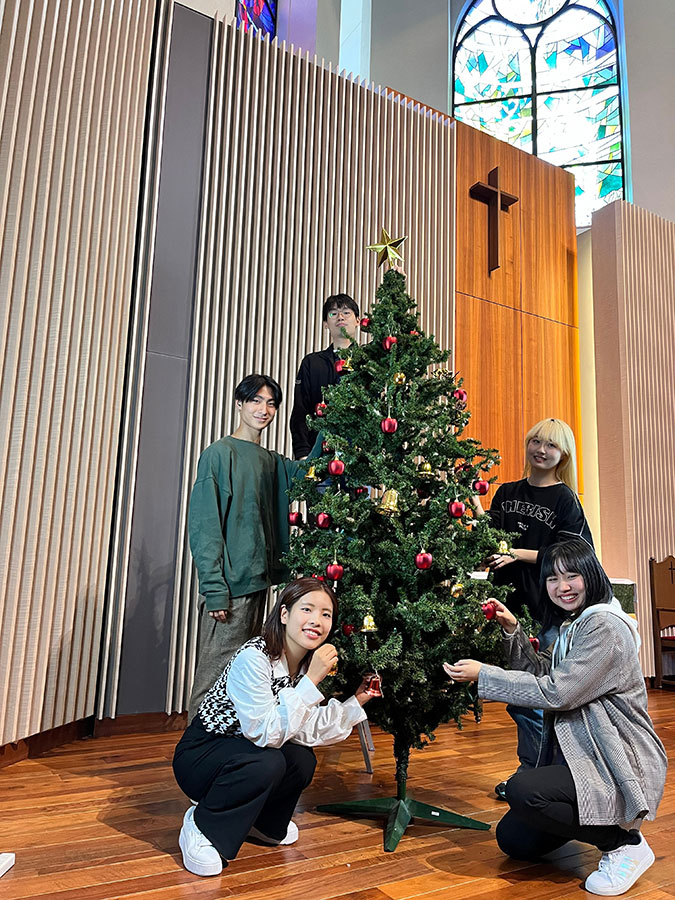 The stained glass, carillon (bell), and pipe organ were moved from Wesley Chapel on the Atsugi campus. Ms. Suzuki is in the front left row.
I attended a worship service for the first time after entering Aogaku, and I found the atmosphere to be more approachable than I had imagined. Through the "Introduction to Christianity" class, I learned that there are various viewpoints in the world, and I think my perspective has broadened considerably. Since there are many Christians all over the world, I think it is important to learn about Christianity to some extent from a College of Literature Department of English standpoint. For my first worship service, I was able to participate with confidence because there was a pre-lecture in the "Introduction to Christianity" class. In Department of Education College of Education, Psychology and Human Studies, there are Bibles and hymnbooks at each seat, so you can attend even if you don't have a Bible or anything like that. The Christmas tree lighting ceremony is bustling with College of Education, Psychology and Human Studies Department of Education, but in contrast, I feel my heart calm in the solemn atmosphere during the worship service. Through daily classes and worship services, I have come to feel that "I myself am the 'salt of the earth' and the 'light of the world'." Learning about a religion whose followers make up one-third of the world's population is beneficial, and knowing that Christianity is sometimes involved in the background of things gives you a new perspective. Goucher Memorial Chapel is a wonderful place to visit anytime, and I really like it because I think it's rare to find a university with such a magnificent chapel. College of Education, Psychology and Human Studies Department of Education and Human Sciences: When you attend a service for the first time, there is a pre-service lecture that explains things like "listen to the sermon during the service and take notes as needed," so don't worry. There are many people from outside the university at the service, and I felt that it is a place open to the community and society. "Introduction to Christianity" has also been a very good learning experience. Until then, I had the image that the birthplace of Christianity was Europe, but I was surprised to learn that it actually originated in the Middle East. Department Department of Psychology College of Education, Psychology and Human Studies Sciences: I had never attended a service before entering Aogaku, but I was able to participate with peace of mind because I was told in advance things like "which page of the Bible to open to." At Aogaku, I was able to study Christianity, which has many believers all over the world, academically, and I had a meaningful time. I think it was meaningful to learn about Christian ideas during the time when I was tired when I first entered university and when I was busy with job hunting in my third year. Attending Faculty of Law Department of Law worship service and listening to the sermon and the sound of the pipe organ, I felt my mind calm down more than I had imagined. In "Introduction to Christianity," while learning about biblical figures and historical figures who made many contributions based on Christian ideas, I not only gained knowledge but also developed the attitude of trying to connect what I learned to my own actions. I have participated in Department of Law Faculty of Law 's Christmas tree lighting ceremony three times. It gets very crowded on the day, so if you want to see it from your desired spot, I recommend going there a little early. It is held outdoors in the cold, but I think it is worth taking the time to participate because of the emotion of the lighting ceremony. In the field of business administration, which I am studying, results and rationality are emphasized, but through Department of Law Faculty of Law, I have come to realize the importance of a perspective that respects "human beings themselves." Knowledge of Christianity is also important in terms of general education, and it has been particularly useful in learning about Irish and British culture. At Goucher Memorial Chapel being in a tranquil space and experiencing the rich sound of the pipe organ allows me to escape the hustle and bustle of everyday life and calm my mind. While on an Department of Business Administration School of Business in France, I told friends that I had studied Christianity at my university in Japan. This created common ground with friends who had similar experiences or were Christian, making it easier to understand their culture. I also realized that even though I myself am not Christian, conveying a basic knowledge and understanding of Christianity made it easier for my friends to explain their background and identity. Faculty School of International Politics, Economics and Communication Department of International Communication / Exchange Program in France: It was my first time attending a worship service since entering Aogaku, and I was surprised by how wonderful the resonant sound of the pipe organ was. The chapel at Aogaku had a gentle atmosphere and was a place I wanted to visit again, which sparked my interest in my local church, which I had previously felt was intimidating. In worship services and classes, I learned the idea that "if you have faith, your life will be richer," based on Aogaku 's educational stance that "faith is the foundation of knowledge." Faculty of School of Cultural and Creative Studies Department of Cultural and Creative Studies

*Unless otherwise noted, the information presented reflects the situation at the time of the interview.